Digitalization has made people’s livelihood services have a temperature of over 20 million people to help their elders pay water and electricity bills.

Cover journalist Zhang Yuexi
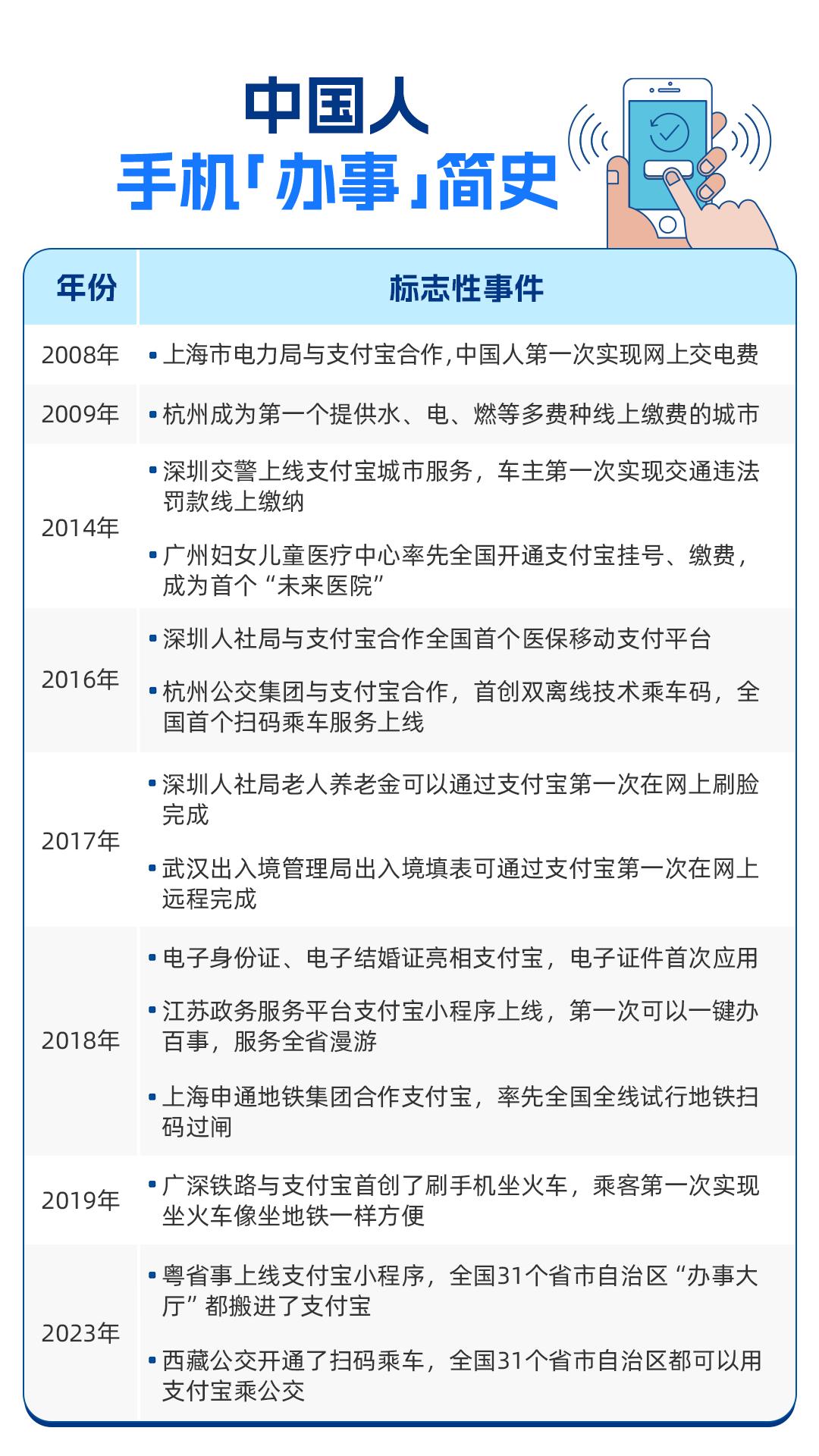
In 2008, the Shanghai Electric Power Bureau did a "trivial matter" that seems very common today-allowing Shanghainese to pay their electricity bills directly with Alipay without running errands and queuing offline. This accident became a starting point, which opened the prelude to the nationwide online service. Fifteen years later, the problems that can be solved by mobile phones have expanded from the payment of water, electricity and coal in those years to five insurances and one fund, social security accumulation fund, illegal payment of fines, hospital registration, transportation and travel, etc. When going out for business, using mobile phones, "less queuing, less running errands and less cards" has become a vivid embodiment of the generalization and convenience of government and people’s livelihood services in China.
On October 31st, Alipay released the 15th anniversary report of people’s livelihood service. The reporter learned that the data shows that up to now, more than half of China families have completed their work payment through mobile phones, among which more than 20 million users have their elders bound to their water, electricity and coal payment accounts; Since the mobile phone registration service was launched, the average number of queues for everyone has been reduced by 180 times; More than 8,000 kinds of public services have been moved online, and a small online program in 31 provinces across the country has been launched on Alipay. Cars in 1300 cities (including county-level cities) can be solved in the APP, and coin-operated change has become history. ……
Helpless queue less:
Mobile phone payment saves a "golden week"
Running around and running errands in order to do a small thing may be a common memory of many people. Before doing things online, people had to go to bank outlets to queue up in order to pay the electricity bill, and even took half a day off for this. When you go to the hospital to see a doctor, you have to queue up for registration, treatment and payment. It used to be a "wonderful scene" to bring Mazar and bedding to the hospital lobby.
In 2008, online shopping was just emerging, and many users called for it to be as convenient as online shopping. Alipay has experienced several months of communication and technical docking with Shanghai Electric Power Bureau, China Everbright Bank and other institutions. In October of that year, the first online payment of electricity charges was completed in Shanghai, and the original one-hour queue was finally shortened to one minute.
According to the platform data, up to now, more than half of China families have used Alipay to pay their living expenses such as water, electricity and coal. If one online payment can save one hour, this "trivial matter" has saved many families a "golden week" (7.5 days) in the past 15 years. Medical care is also a major pain point for people’s livelihood. Data show that up to now, more than 300 cities and 3,500 hospitals in China have provided patients with online registration, online payment, report inquiry and other services through Alipay. The optimization of these medical procedures can help patients avoid queuing for 3-4 times each time. Based on the average annual number of medical visits per capita published by National Health Commission, over the years, the average number of queues for each person has been reduced by 180 times.
Doing things on the Internet more than running errands, and the digitalization of people’s livelihood services greatly reduces the helpless waiting. Nowadays, young people can freely choose to queue up for their own interests and personal development, and get a glimpse of the social changes in China.
Care for the elderly is much more;
More than 20 million people help their elders pay water and electricity bills, and 70% users tie up medical insurance for the "old and young"
Young people are the main force of mobile phone services, but the convenience of the digital age has also benefited the elderly at home by paying and operating on behalf of others. According to relevant data, more than 20 million users have added their elders to their payment accounts, so that the elderly don’t have to queue up hard.
In the past, the old people were most afraid of forgetting to bring their medical insurance card or the card balance was not enough. Since this year, the "family account" function of medical insurance electronic certificate has been launched to pay Alipay, which supports users to help their families activate the medical insurance electronic certificate, so that the old people who don’t have smart phones can also see a doctor and buy medicines on the code. The data shows that about 70% people use medical insurance family accounts to help the "one old and one young" at home to bind medical insurance. In addition, there are medical insurance families to help each other, so that the amount of medical insurance can be used by the elderly at home; Old people live with their children in other places, or they can seek medical treatment in other places for the record, so as to avoid the trouble of running back to their hometown for reimbursement.
Users can help their families activate medical insurance electronic certificate.
Let digital services benefit the elderly, and many government agencies are also launching innovative measures. Jiangxi government services have taken the lead in launching the "elderly area" in the country, providing large-character versions and voice search services for the elderly. Old people who are retired and inconvenient to travel can prove that they have the qualification to receive security money by brushing their faces or acting on behalf of relatives and friends through "Ganfutong".
The geographical digital divide has narrowed:
The national service hall is "surfing the Internet" and the wind of scanning the code by car has blown to Xizang.
In 2021, mobile phone payment for water, electricity and coal was introduced in Ali, Tibet. In September, 2023, the wind of bus scanning code was also blown to Lhasa, Xizang. Now, herders in Tibetan areas, together with urban white-collar workers in Beijing and Shanghai, have the same digital service experience in such trivial matters, and the digital gap between regions is also narrowing. "Since 2018, we have been actively promoting mobile payment, hanging the receipt code on the bus and scanning the passengers on the bus. Now it has evolved into direct code brushing. Many people don’t know that mobile payment in Xizang has developed very fast. According to the data, mobile payment in Xizang ranks first in the country for five years," said Mi Malam, director of the cashier center of Lhasa bus operation company.
According to the report data, there are already 1,300 cities (including county-level cities) in China that support scanning code to ride, and coin-in and change-in by car have become history. The average annual service of platform travel business exceeds 8 billion person-times, and the average annual carbon emission reduction exceeds 500,000 tons.
The development of digital government affairs has also brought the experience of ordinary people in different regions closer together. In 2015, the State Council issued "Guiding Opinions on Actively Promoting the internet plus Action", and "internet plus" was written into the government work report, and "Internet+government services" was vigorously promoted, so that residents and enterprises could run fewer errands, handle affairs better and avoid congestion, and various institutions also launched innovative "online services". The data shows that from 2015 to today, 31 provinces, 60 cities and over 30 national service platforms across the country have opened Alipay applets, providing more than 8,000 kinds of online public services including public security, social security, provident fund, taxation, civil affairs, education, water and electricity, transportation and travel, and the citizens have changed from "running at most once" to "not running at all".
The data proves the development of digitalization and the achievements of building a service-oriented government in China, and also witnesses the changes of the times and the temperature of social sentiment.
Reporting/feedback

What are the steering wheel position adjustment methods of Bao Junyue 2023?

Baojun Yueye, model 2023, the steering wheel position is adjusted manually up and down.

Bao Junyue is also a small SUV model, which adopts the latest design and technology and provides excellent driving experience and dynamic performance. This model is equipped with an efficient engine, which can output strong power and make drivers feel infinite pleasure during driving. At the same time, Bao Junyue is also equipped with a series of advanced driving assistance systems, such as electronic stability control system and brake assistance system, which greatly improves the safety and comfort of driving.

In terms of driving experience, Bao Junyue also performed very well. Its precise steering and flexible suspension system make it easy for drivers to control and enjoy driving. In addition, Bao Junyue also has excellent chassis adjustment, which can effectively absorb shock and maintain the stability of the car body, so that drivers can feel a more stable driving experience during driving.

In terms of power, Bao Junyue is also equipped with a high-performance engine with a maximum power of 150 HP and a maximum torque of 250 Nm, allowing drivers to feel strong power output when accelerating and overtaking. In addition, Bao Junyue also adopts advanced transmission technology, which can realize fast gear shifting and smooth driving process, so that drivers can feel smoother power output during driving.

Generally speaking, Bao Junyue is also an excellent model, and its excellent driving feeling and dynamic performance allow drivers to enjoy unlimited pleasure and fun during driving. If you want to experience an excellent SUV model, Bao Junyue will also be a good choice.

Bao Junyue is also a small SUV, and its cruising range is a key word that consumers are very concerned about. According to the official data, Baojun Yueye’s cruising range is 305 kilometers, which is based on the NEDC test standard. However, the cruising range in actual use will be affected by many factors, such as driving style, road conditions, temperature and so on. On urban roads, Baojun Yueye has a good cruising range, which can meet the needs of daily commuting and short-distance travel. On the highway, the cruising range will decrease and you need to charge more frequently. In addition, Bao Junyue’s charging time is also relatively short, and it only takes about 2 hours to fully charge.

In addition to cruising range, fuel consumption is also a concern of consumers. The fuel consumption performance of Baojun Yueye is related to driving habits and road conditions. Under normal circumstances, its fuel consumption is between 4-6 liters /100 kilometers. Compared with traditional fuel vehicles, Baojunyue also has lower fuel consumption, which can save consumers a lot of money.

In general, Baojunyue is also a small SUV, and its cruising range and fuel consumption performance are excellent, which can meet the daily needs of consumers. Baojun Yueye’s exterior design is young and fashionable, and the interior comfort is also good. In terms of configuration, it is equipped with many practical functions, such as reversing radar, automatic parking, lane departure warning, etc., which can improve the safety and convenience of driving. In addition, the price of Bao Junyue is also relatively close to the people, and it is a cost-effective model.

Bao Junyue is also a very practical small SUV model, and its space performance is excellent, which can meet the needs of daily family travel. In terms of body size, its length, width and height are 4155*1725*1635mm and the wheelbase is 2550mm, so the body is compact without losing the atmosphere. In terms of space, Bao Junyue also provides enough head space and leg space, so that passengers can stretch out comfortably in the car without feeling cramped. In addition, its rear seats also support proportional reclining, which increases the flexibility of storage space. The interior space layout is reasonable, and the front seats also have heating and ventilation functions, providing passengers with a more comfortable ride experience. In addition, Bao Junyue is also equipped with rich storage space and humanized design, such as the storage compartment and cup holder under the center console, which is convenient for drivers and passengers to store small objects. Generally speaking, Baojun Yueye has excellent space performance and is a very practical small SUV model.

India wants to build a space station in 2035, and "procrastination" may not be completed on time.

A few days ago, Somanath, chairman of Indian Space Research Organization (ISRO), revealed the latest progress and plans of India’s manned space program at a conference jointly sponsored by Indian Surveying and Mapping Society (ISG) and Remote Sensing Society (ISRS), among which the development plan of India’s manned space station in the future attracted the most attention.

With the advancement of India’s "Gaganyaan" manned spacecraft program, India’s manned space station program will also be put on the agenda. It is planned to launch and deploy the first verification module of the space station around 2028 and build the Indian space station in 2035 — — Bharatiya Antariksha Station。 So, what is the level of the Indian space station?

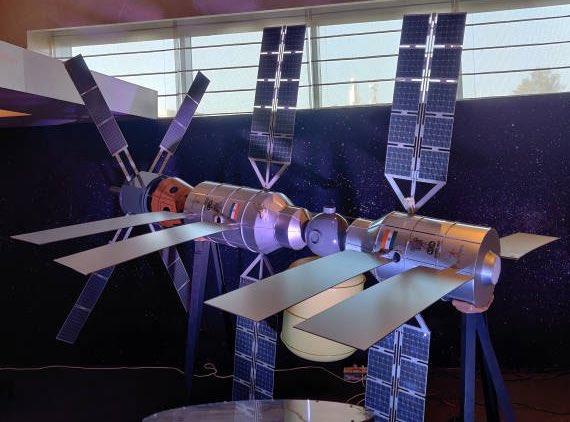
The space station model announced by India.

India’s manned space flight: struggling to move forward

Manned space flight is an important symbol to measure a country’s comprehensive strength today. For India, which wants to become a "great country with great sound and color", manned space flight is obviously a plus item. In 1984, through international cooperation with the Soviet Union, the Indian Space Research Organization sent India’s first astronaut Sharma into space. He took the Soyuz T-11 spacecraft to the Salute 7 space station and made a space flight for 7 days, 21 hours and 40 minutes.

Borrowing a ship to the sky is just a pathfinding move to develop the ability of autonomous manned space flight. The ultimate goal is to send Indians into space by their own rockets and spacecraft. But India has lacked the necessary space capability for a long time, and even mature and reliable rockets did not exist before the 21st century — — It is the 21st century that the PSLV rocket independently developed by India has reached a mature and reliable state. Although the carrying capacity of the PSLV rocket is enough to launch a spacecraft of the same level as the American Mercury, the Indian Space Research Organization has long been in contact with the Soyuz spacecraft, and it is obvious that it will not "go backwards" to develop a spacecraft with a lower technical level like Mercury. The launch mass of Soyuz spacecraft is 6.8 tons, while the capacity of GSLV MK II rocket in low-earth orbit is 6 tons. It is rumored that India had planned to launch a manned spacecraft with two crew members with GSLV MK II rocket, but the performance of GSLV MK II rocket also made India a little disappointed — — Achieving maturity is something after 2010.

Although the manned space program has not been formally approved by the state, in order to promote the manned space program, the Indian Space Research Organization began to accumulate the technology and experience of manned space engineering in advance. In January, 2007, the Indian Space Research Organization launched a test module named Space Capsule Return Test (SRE). SRE-1 is just a simple return module. After being launched by PSLV rocket, it flew in low earth orbit for about a week, and then re-entered and landed on the sea surface of the Bay of Bengal. The Indian Space Research Organization has broken through the reentry technology of manned spacecraft through the SRE-1 return module, and the thermal protection tiles of the thermal protection system can be reused.

The Indian Space Research Organization (ISRO) subsequently proposed to launch a manned spaceflight project, and planned to send Indians into space by 2015. However, this plan did not receive strong support from the Indian government, and the Indian government only approved a budget of 20 million US dollars for technical pre-research. ISRO can only continue to tackle technical problems first. In 2008, the Indian Space Research Organization decided to build an astronaut training center in Bangalore, and developed spacesuits inside and outside the cabin. It also prepared for the construction of a manned space mission control center and attempted to build a special manned space launch station at the Sri Harikota launch site. In 2012, India’s "Twelfth Five-Year Plan" was announced, and the manned space program has not yet been approved, which means that India’s manned space program was officially launched after 2017 at the earliest.

With the maturity of the GSLV MK II rocket and the successful development of the new generation GSLV MK III/LVM3 rocket, on December 18th, 2014, the Indian Space Research Organization carried out the suborbital test flight of LVM3 and launched the manned module for atmospheric re-entry experiment (CARE). The CARE manned module, weighing about 3.7 tons, is a full-scale test module of the manned spacecraft in the future. It was accelerated to a speed of 5.3 km/s and re-entered, and many key subsystems such as navigation, guidance and control and thermal protection were tested. Of course, such a large return capsule also means that the GSLV MK II rocket can only "look at the ship and sigh", and it is necessary to use the LVM3 rocket with greater capacity to launch a manned spacecraft. In addition, India has also carried out airdrop and water splash tests of manned return capsule, and the development of service capsule of spacecraft has also made progress. Indian Space Research Organization directly developed the service capsule of manned spacecraft on the basis of the fourth stage of PSLV rocket.

In 2017, the Indian Space Research Organization began to implement the manned space program, and successfully completed the launch pad escape test in 2018. On August 15, 2018, on the National Day of India, Indian Prime Minister Modi officially announced the manned space program called Gaganyaan. At that time, it was planned that the project budget would total 100 billion rupees (about 1.35 billion US dollars) in the next seven years. The Indian Space Research Organization also disclosed that the manned spacecraft is a typical two-cabin spacecraft with a total weight of about 7 tons. They plan to transport three members for a 5-7-day flight in 2021. The Indian Space Research Organization also sent astronauts to Russia for training, and established a ground station in Australia through international cooperation to support future manned flights.

However, with the development of the spacecraft, the plan has not changed quickly. The manned return module has become a large manned module with a weight of 5.3 tons, while the service module has a weight of 2.9 tons, and the total weight of the spacecraft has increased to 8.2 tons. The Gaganyaan spacecraft will be sent into a circular orbit with a height of 400 kilometers by a LVM3 rocket that has passed the manned certification. The Indian Space Research Organization obviously underestimated the engineering difficulty of manned spaceflight. Coupled with the impact of the epidemic, the first hot test of the manned version of the rocket Vikas was carried out in July 2021, the main parachute airdrop test was carried out in 2022, the parachute test was completed in August 2023, and the spacecraft escape test was carried out on October 21 of the same year. Like most space programs in India, the manned space program is also plagued by "procrastination". The first unmanned launch of Indian manned spacecraft has been postponed to 2024, and the first manned flight plan will be realized in 2025.

Manned space station: a vision full of variables

There is a saying in the aerospace field: shipbuilding is for building a station, and building a station is for application. Manned spacecraft is only the first step of manned spaceflight project. Manned spaceflight is to serve space applications after all, and space station is an essential infrastructure for large-scale space science and applications. Although India has not yet launched a manned spacecraft, it has already carried out the pre-research work of a manned space station.

In 2018, India’s manned spaceflight project was officially approved. In June 2019, Sivan, chairman of the Indian Space Research Organization, revealed that India is preparing to develop and launch a space station in the next stage. It is said that the Indian Space Research Organization will launch a 20-ton single-cabin space station with the class of "Salute VII" around 2030, support short-term space stay of 15-20 days, and carry out space microgravity scientific experiments. Manned space engineering technology covers a wide range, among which rendezvous and docking is an indispensable key technology, and the Indian version of Salute VII space station should also break through the mastery of space rendezvous and docking. In 2019, Indian media reported that the Indian Space Research Organization had started research on space docking technology as early as 2017, and two small satellites would be launched in the future to carry out space docking experiment (SPADEX).

In 2021, at the Global Space Exploration Conference (GLEX 2021), Swan, chairman of the Indian Space Research Organization, mentioned that India will develop a manned space station in the future to achieve long-term orbital residency. In his slide show, the core module of the space station is docked with two Gaganyaan spacecraft, and there are two suspected experimental modules. The core module also has a mechanical arm and an airlock module, and the performance index is greatly improved compared with the original "Salute" series of space stations. According to public information, the Gaganyaan spacecraft, which had planned to make its first flight at the end of 2021, was postponed to 2023, but in 2022, President Swan continued to say that this larger and more complex space station would be built around 2030.

In 2022, the Indian Space Research Organization showed a new space station model. This space station named the microgravity experimental manned orbital space station (HOME) consists of a service module, a residence module, a propulsion module and an inflatable module. It is exaggerated that there are not only three conventional modules, but also two inflatable modules on the HOME model, and four Gaganyaan spacecraft have been docked! However, considering that the Indian manned spacecraft has not yet been launched, the Indian Space Research Organization mainly focuses on the manned spacecraft, and the various manned space station configurations on display are of little reference value. In the future, with the implementation of India’s manned spaceflight project and the changes of India’s economic development and government support, the design scheme of the space station will be revised at any time. In an interview, Somanat, the newly appointed chairman of the Indian Space Research Organization in 2023, said that the Gaganyaan plan aims to achieve independent space flight capability. Once the manned space flight capability is broken, the space station plan will be implemented in the next 20 to 25 years. The space station has been identified as the main goal of the Indian Space Research Organization in the next decade. Judging from the available information, the Indian Space Station is no longer an imitation of Salute VII, but a typical multi-module space station.

The design of the Indian Space Station is also constantly changing. In November 2023, the chairman of the Indian Space Research Organization, Somanat, presented a slide at the conference. It is planned to use Gaganyaan spacecraft to carry a small inflatable capsule in 2026-2028, test the deployment technology of the inflatable capsule in orbit, and then conduct the rendezvous and docking test in orbit. He also mentioned that the Indian Space Station includes three cabins, namely, living cabin, command and propulsion cabin and inflatable cabin. The total mass of the space station is about 25 tons, and the construction of the space station will be completed around 2035. The Indian manned space station has not been formally established. Whether it is the completion time in 2035, the total mass of 25 tons, or the design configuration of the three cabins, it is obviously uncertain. The Indian space station plan will continue to change.

According to the information released by the Indian Space Research Organization, Gaganyaan spacecraft will be launched by LVM3 rocket. In the existing scheme, the space station module will also be launched by LVM3 rocket, and the low-earth orbit capacity of LVM3 rocket is only about 10 tons, which may be the key to the total mass of the three-cabin space station being only 25 tons.

The first flight of LVM3 rocket in 2017 is not the end of the development of Indian launch vehicle. The Indian Space Research Organization is improving and upgrading the LVM3 rocket, and plans to increase the synchronous transfer orbit capacity of the rocket from 4 tons to 6-6.5 tons, and the corresponding near-earth orbit capacity can also reach about 15 tons. In addition, India is still developing a new generation of rocket NGLV, which will replace the existing launch vehicles such as PSLV, GSLV and LVM3. The NGLV rocket has a capacity of 20 tons in low-earth orbit and is scheduled to make its first flight around 2030.

Somanat, chairman of the Indian Space Research Organization, also said that NGLV rockets will be used to support future commercial launches, deep space exploration and manned space missions, and the current 25-ton space station may be an expedient measure. With the development of NGLV rockets, the Indian Space Research Organization is likely to develop 20-ton cabins and build a large permanent space station with three or more cabins. The Indian space station plan looks ambitious, but there are still many key technologies that need to be broken through, and it is likely that, like most Indian space programs, it will not be completed on time. Moreover, many Indian space programs are ambitious and divorced from India’s space industry and technical level, and the actual results are quite different from PPT.

Explain in detail the chassis improvement of the new generation SAIC-GM New Excelle.

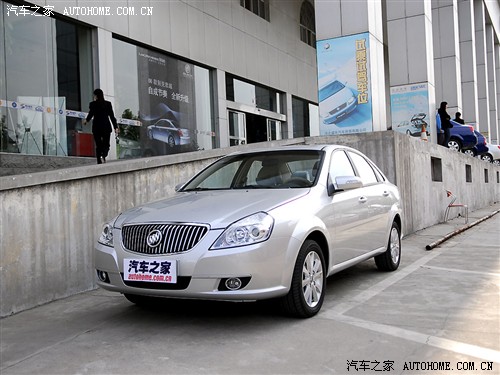
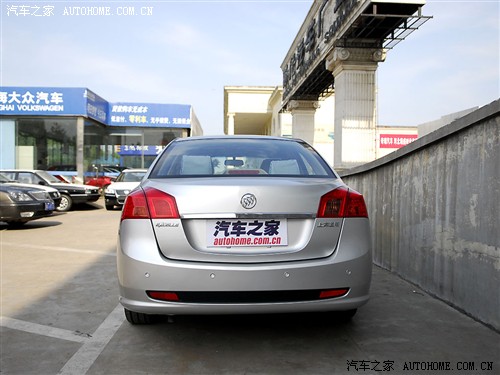
  Excelle, which went public in 2003 and has entered the fifth sales period, lacks a real replacement model. Although Shanghai GM claims that the new Excelle just listed is a "vertical replacement" model, it has been choked by many netizens that it is a change of soup. Aside from the changes in internal and external styling, where is the improvement of the new Excelle in the chassis?


Car home GM Buick Excelle 08 1.6LE-MT


"New Excelle"


  Although Shanghai GM claims that the new Excelle just listed is a "vertical replacement" model, it has been choked by many netizens that it is a change of soup. Where is the improvement of the new Excelle chassis?


● It is not a multi-link, and the rear suspension of the new Excelle has not changed.


  Calling the rear suspension structure of Excelle a multi-link structure has become a "popular" misunderstanding since it was just listed, and even many sales representatives pointed to two obvious links in the rear suspension of Excelle, which made many consumers "seeing is believing". On the occasion of the listing of the new Excelle, the theory of "multi-link rear suspension" once again surfaced. In fact, the rear suspension structure of Buick Excelle has not changed as a mid-term modified model, and the rear suspension of Excelle is not the legendary multi-link rear suspension.


Car home GM Buick Excelle 08 1.6LE-MT


"It is a misunderstanding that the rear suspension structure of Excelle is called multi-link structure since it was just listed."


  Excelle’s rear suspension structure should be a two-link strut independent suspension, which belongs to a variant of McPherson independent suspension used for rear suspension. It is very similar to McPherson’s independent suspension structure, and the shock absorber is also used as the pillar. However, the A-shaped lower arm with left-right steering motion function in McPherson suspension is replaced by two tie rods hinged with bolts. Because the steering function is not needed in the rear suspension, engineers have strengthened the connection stiffness by limiting the degree of freedom.


"Many sales representatives pointed to two obvious connecting rods in the rear suspension of Excelle, which made many consumers" seeing is believing ""


  However, these two tie rods, which replace the A-type lower arm, are interpreted by many sales representatives as the so-called "connecting rods" in multi-link suspension. In fact, these two tie rods can only be said to be seemingly connecting rods, but they are not really connecting rod structures. In curve performance, the stability and support stiffness of connecting rod strut suspension are not very satisfactory. Therefore, the two-link strut independent suspension still has obvious handling performance gap compared with the real four-link independent suspension.


● Where is the improvement of the new Excelle chassis?


  Consumers who have driven the old Excelle will be deeply impressed by the emergency sideline of Excelle and the dynamic performance of the body that tilts and shakes when entering the corner. This time, in the chassis improvement of the new Excelle, Shanghai GM has made improvements for the large roll angle and soft suspension setting of the old Excelle.


"Shanghai GM has made chassis improvement for the old Excelle with large roll angle and soft suspension setting."


  By increasing the stiffness of front and rear springs by 40%, increasing the damping of front and rear shock absorbers by 26% and 43% respectively, and increasing the diameter of the front and rear ends of the stabilizer bar, the new Excelle has improved the suspension setting and favored the tough design preferred by China consumers. Because the spiral springs and shock absorbers are more rigid, the steering body roll is reduced, the steering sensitivity is increased, and the vehicle handling is enhanced. Of course, you can’t have your cake and eat it. When the road is bumpy, the more rigid suspension system equipped by the new Excelle will be difficult to filter and absorb the vibration well, and the comfort will be affected.


● The suspension structure of the new generation Excelle in 2009 will be greatly changed.


  The rear suspension form of the new Excelle still maintains the two-link strut independent suspension. This suspension structure was very popular in the 1980s, because although it has a performance gap with multi-links, it also has good characteristics: the moving parts of the suspension are simple, the structure is light, and the movement stroke of the suspension is large, which can achieve good comfort. However, with the development of suspension technology, the two-link strut independent suspension has gradually fallen out of favor. Many compact cars pursuing handling performance orientation have adopted more advanced four-link rear suspension structure, while compact cars or small cars pursuing balanced orientation have turned to more cost-effective and compact torsion beam trailing arm rear suspension.


"GM will use the torsion beam to drag the arm rear suspension in the new generation of Excelle models launched in 2009."


  At present, Tianjin, Tianjin and other older models still use two-link strut rear independent suspension. However, from Tianyu, the follow-up model of Antelope, and the rear suspension structure of New Elantra, the follow-up model of Elantra, have turned to the torsion beam to drag the arm rear suspension, which shows the general trend. And GM will also use the torsion beam to drag the arm rear suspension in the new generation of Excelle models launched in 2009.


● Summary: New Excelle has some adjustments.


  Seeing this, I believe that you have some understanding of the chassis improvement of the new Excelle.
 
  From the suspension structure form, the new Excelle belongs to the change of soup without changing medicine, so it is hard to say that it is a real "vertical replacement". However, as a mid-term modified model, the change of the new Excelle is still satisfactory, which has adjusted many problems such as soft suspension and large roll. The medicine was not changed, but the proportion of ingredients was adjusted. It remains to be seen whether Shanghai GM can be recognized by consumers. (Text/Li Yi)

Comments on A-shares: Shanghai Composite Index closed down 0.27%, and nearly 80 shares in the ST plate fell to the limit of 21 ST Aikang.

  The three major indexes of A-shares are mixed today. At the close, the Shanghai Composite Index fell by 0.27%, the Shenzhen Component Index rose by 0.07%, the Growth Enterprise Market Index rose by 0.79%, the Beizheng 50 Index fell by 2.10%, and the turnover of Shanghai, Shenzhen and Beijing was 834.1 billion yuan, including 830.7 billion yuan in Shanghai and Shenzhen, which was 115.7 billion yuan more than the previous day. More than 4,400 stocks in the two cities fell.

  In terms of plate theme, copper cable high-speed connection, memory chip and aquaculture plate were among the top gainers; Non-ferrous metals, ST plate and Internet e-commerce were among the top losers.

  On the disk, the memory chip continued to be active, () 3 boards were connected, (), () and () were daily limit, and Baiwei storage rose by over 10%. The concept of copper cable high-speed connection led the rise all day, () daily limit, (), () and () rose by over 10%. Pork stocks rebounded, () daily limit, () and () were among the top gainers. The concept of industrial metal led the decline, () fell, (), () followed. ST plate continued to fall, (), (), ST Zhongrun nearly 80 shares down. The stocks inquired about the annual report plunged in succession, with (), (), (), () and other stocks falling, while (), () and () fell by more than 10%.

  Plate analysis:

  Straight flush hot stock list:

  Transaction review:

  At 09: 25, A shares opened, the Shanghai Composite Index opened 0.03% lower, the Shenzhen Component Index opened 0.06% lower and the Growth Enterprise Market Index opened 0.07% higher.

  At 09:26, the concept of humanoid robot was active at the beginning, () rose by over 15%, followed by (), Buke, () and central control technology.

  At 09:27 (), the market closed down. In the news, the Fund Supervision Department of the National Medical Insurance Bureau interviewed Yinxintang Pharmaceutical Group Co., Ltd.

  At 09:28, the concept of non-ferrous metals fell at the beginning, () fell by more than 7%, followed by Huayu Mining, (), Sheng Da Resources, () and ().

  09:31 The concept of consumer electronics continued to be active, () 2 consecutive boards, () rose by over 10%, and Derun Electronics, (), (), () and so on quickly followed.

  At 09:33, the concept of memory chip rose sharply, and the western test rose by over 15%, followed by Baiwei Storage, Wanrun Technology, (), Zhongwei Company and ().

  At 09:37, the banking sector fell in early trading, () fell more than 8%, followed by (), (), Bank of Ningbo and China CITIC Bank.

  At 09:38, the Hang Seng Technology Index rose to 2%, and the Hang Seng Index is now up 1.66%.

  At 09:42, the concept of gold changed, and Huayu Mining fell, followed by (), (), Sheng Da Resources, () and ().

  09:49 The Hang Seng Science and Technology Index rose over 3%, and the Hang Seng Index is now up 2.41%.

  At 09:50, the copper cable high-speed connection plate oscillated strongly, and Shenyu shares rose by more than 10%, followed by Dingtong Technology, Zhongfu Circuit, Shenglan Shares, () and ().

  09:52 The media sector bottomed out and rose, () 3 consecutive boards, (), (), (), (), (), (), () and so on quickly followed up.

  At 09: 55, the three A-share indexes turned red in intraday trading, with memory chips, automobile services and aquaculture among the top gainers.

  09:59 The semiconductor and component sectors continued to be active, with Minxin shares rising by over 15%, Baiwei Storage by over 10%, Zhongfu Circuit, (), Shengyi Electronics and Fudan Microelectronics by over 5%.

  10:00 According to () iFinD data, half an hour after the opening, the turnover of Shanghai and Shenzhen stock markets reached 261.6 billion yuan.

  At 10:04 (), it hit the daily limit, with a turnover of 859 million yuan.

  At 10:04, FTSE China A50 index futures rose more than 1% in the day.

  At 10: 05, the ST plate continued to fall, with more than 30 stocks such as (), ST Sunshine, () and () falling, while (), ST Jiayu and () fell more than 10%.

  At 10:10, the concept of humanoid robot rose and strengthened, and Siling shares went up, and (), Fengli Intelligent, (), Buke shares and () all strengthened.

  At 10: 12, CPO concept stocks rebounded, Shengyi Electronics rose by more than 10%, () rose by more than 7%, () rose by more than 5%, and Yuanjie Technology, (), () and () followed suit.

  At 10:15, the education stocks fell, () stopped, and (), (), (), (), () and () followed.

  At 10:31, the main contract of live pigs rose by 4% in the day, and it is now reported at 18,660.00 yuan/ton.

  At 10:31, the aquaculture sector oscillated and rebounded, and Guanghong Holdings rose over 8%, followed by (), (), (), Zhenghong Technology and (). In the news, the main contract for live pigs rose by 4% in the day and is now reported at 18,660.00 yuan/ton.

  At 10:32, the Growth Enterprise Market Index rose to 1%, the Shanghai Composite Index rose by 0.32%, and the Shenzhen Component Index rose by 0.6%. The memory chips, humanoid robots and aquaculture sectors were among the top gainers.

  At 10:49, the game stocks fluctuated lower, () fell, and (), (), (), (), (), () and so on followed.

  At 11: 05, the concept of PCB moved up, () went up, (), (), (), (), (), () and so on.

  At 11:09, the main contract of manganese silicon futures of Zhengshang Institute fell by 6.59% to 8762.0 yuan/ton.

  At 11:11, the main contract of ferrosilicon hit the daily limit, with a decrease of 8% to 7428 yuan/ton.

  At 11:12, the main contract of manganese silicon hit the daily limit, with a decrease of 8.02% to 8628 yuan/ton.

  11:13 According to the straight flush iFinD data, up to now, the turnover of Shanghai and Shenzhen stock markets has exceeded 500 billion yuan, including 218 billion yuan in Shanghai stock market and 283.3 billion yuan in Shenzhen stock market.

  At 11: 25, the recent annual report of A-shares was inquired, and many stocks fell sharply, such as Langyuan, Smith Barney, Meierya, Rock and (), and Hanyu Pharmaceutical, Jinlihuadian and Lingpai Technology fell more than 10%.

  At 13:02, the real estate development sector weakened in the afternoon, () stopped, and (), (), (), () and () followed.

  At 13:16, the Beizheng 50 index fell more than 2% in the afternoon.

  At 13:24 (), the intraday limit was lowered, and the ceiling was staged, with a turnover of 111 million yuan.

  At 13:26, the concept of commercial aerospace changed locally. (3 days and 2 boards, western test and test, () rose by more than 10%, and (), (), () and () followed suit.

  At 13:41, the main contract of Shanghai Bank fell 4% in the day, and it is now reported at 7920.00 yuan/kg. Spot silver fell by 1% in the day and is now reported at $30.08 per ounce.

  At 13:47, pork stocks fluctuated and rebounded, Zhenghong Technology had a daily limit, and Guanghong Holdings rose more than 8%. (), Xiangjia Shares, () and Yisheng Shares followed suit.

  At 13:55, the power stocks fluctuated lower, () approached the daily limit, and (), (), (), (), () and () fell more than 5%.

  News:

  1. The PMI of Caixin manufacturing industry in China in May was 51.7.

  Caixin China Manufacturing Purchasing Managers Index (PMI) in May 2024 announced today recorded 51.7, up 0.3 percentage points from April, the highest since July 2022, indicating that the expansion of manufacturing production and operation activities has accelerated.

  2. Goldman Sachs: It is expected that the China stock market will go further.

  In a report, Goldman Sachs raised the 12-month target point of MSCI Asia-Pacific Index (excluding Japanese) from 580 to 615, which was driven by the upward forecast of profit growth and optimistic view on China, and said that the rally of China stock market could be sustained. The MSCI Asia Pacific (excluding Japan) index closed at 547.5 last Friday, and Goldman Sachs’ estimate means that the index has about 12% upside. The bank maintains an over-rated rating on North Asia (A shares, Japanese shares and Korean shares), Indian stock market and Indonesian stock market.

  3. Relevant authorities support the upcoming release of the 5G development policy.

  On June 6 this year, China’s 5G ushered in an important time node for the fifth anniversary of licensing. The Ministry of Industry and Information Technology will jointly hold the "Mobile Communication High-quality Development Forum" to systematically summarize the achievements and experiences of China’s mobile communication, especially the 5G industry leading the high-quality development of the digital economy, and encourage the whole industry to continuously consolidate and enhance its leading position and competitive advantage. The reporter was informed that during the forum, the competent authorities will be released to support the 5G development policy and make an authoritative interpretation. At the same time, a launching ceremony will be held: hand in hand to open a new era of 5 G-A. (Securities Times)

  4. Tesla responded to the rumor that "single pedal mode is banned": it does not affect existing products and functions.

  Regarding the recent rumors about Tesla’s single pedal mode or being banned in the market, Tesla responded to reporters that this standard has not yet been officially released and implemented, and does not affect existing products and functions. Recently, the Ministry of Industry and Information Technology has publicly solicited opinions on a mandatory national standard "Technical Requirements and Experimental Methods for Passenger Car Braking System", which involves changes in the application conditions of energy recovery braking function for new energy vehicles. In this regard, there is a voice in the market that Tesla single pedal mode may be banned. (Shell Finance)

  5. South Korea said that it would stop the effectiveness of the Panmunjom Declaration Agreement on Military Field Implementation.

  According to the report of the South Korean President’s Office on June 3, local time, the effectiveness of the Panmunjom Declaration Implementation Agreement in the Military Field will be suspended before the trust between the ROK and the DPRK is restored. The Panmunjom Declaration Military Implementation Agreement is a subsidiary agreement of the Pyongyang Joint Declaration in September. It was signed in September 2018 by Song Yongwu, then Minister of National Defense of the Republic of Korea, and Sanu Guangtie, then the Korean people’s armed force. The agreement aims at eliminating the threat of war on the Korean Peninsula, ending military hostile relations including unarmed zones and building the Korean Peninsula into a "permanent peace zone". (CCTV News)

The exposure size of Mercedes-Benz EQE road test spy photos is close to E-class/endurance or up to 600km.

A few days ago, Driving Sight got a group of brand-new pure electric medium and large cars from overseas media.<——奔驰EQE的测试谍照。新车内部代号为V295,并有望在2022年正式首发亮相。

In terms of appearance, the exterior of the test car is covered with camouflage stickers, but we can still find some details through the overall shape and exposed part of the new car. For example, the overall line shape of the new car is similar to the previously exposed Mercedes-Benz EQS test car. But compared with EQS, EQE is more compact. At the same time, the tail of the new car leans downward, which has a sedan style and is more dynamic. It is worth mentioning that the test car uses a protruding taillight at the tail, which is more chic.

According to the information previously exposed, EQE will be built based on Mercedes-Benz’s brand-new MEA electric platform, and a large number of lightweight aluminum alloy materials will be used on the car body. In terms of body size, EQS will be close to Mercedes-Benz E-Class, but the internal space will catch up with Mercedes-Benz S-Class.

In terms of power, the new car will be equipped with front and rear dual motors and provide a four-wheel drive system. The two motors are located at the front axle and rear axle of the vehicle respectively. The maximum power of the system will reach 308 HP and the maximum torque will be 765 Nm. The new car’s pure electric comprehensive cruising range can reach 600km. Regarding the latest news of Mercedes-Benz EQE, the driving sight will continue to pay attention and bring reports in the first time.

Guangdong, a consumer center city, intends to do this!

Since the beginning of this year, the epidemic has broken out at many points, and the complexity, severity and uncertainty of the internal and external economic development environment have increased. Building a consumption center city is an urgent need to stabilize the economic market and promote economic growth; It is also an internal demand to promote high-quality development and create a high-quality life; It is also an important measure to expand domestic demand and serve to build a new development pattern.

In order to promote the upgrading and expansion of consumption in Guangdong Province, enhance the effect of consumption agglomeration, and combine the cultivation and development of international consumption center cities and regional consumption center cities, on August 26, it was led by Guangdong Provincial Department of Commerce and Shenzhen Municipal People’s Government, undertaken by Shenzhen Municipal Bureau of Commerce and Shenzhen Futian District People’s Government, and co-organized by Guangzhou, Zhuhai, Shantou, Foshan and other Guangdong multi-city commercial bureaus.Launching Ceremony of 2022 Guangdong Consumer Center Urban Characteristic Activities and Consumer Center Urban Development ForumSuccessfully held in Shenzhen.
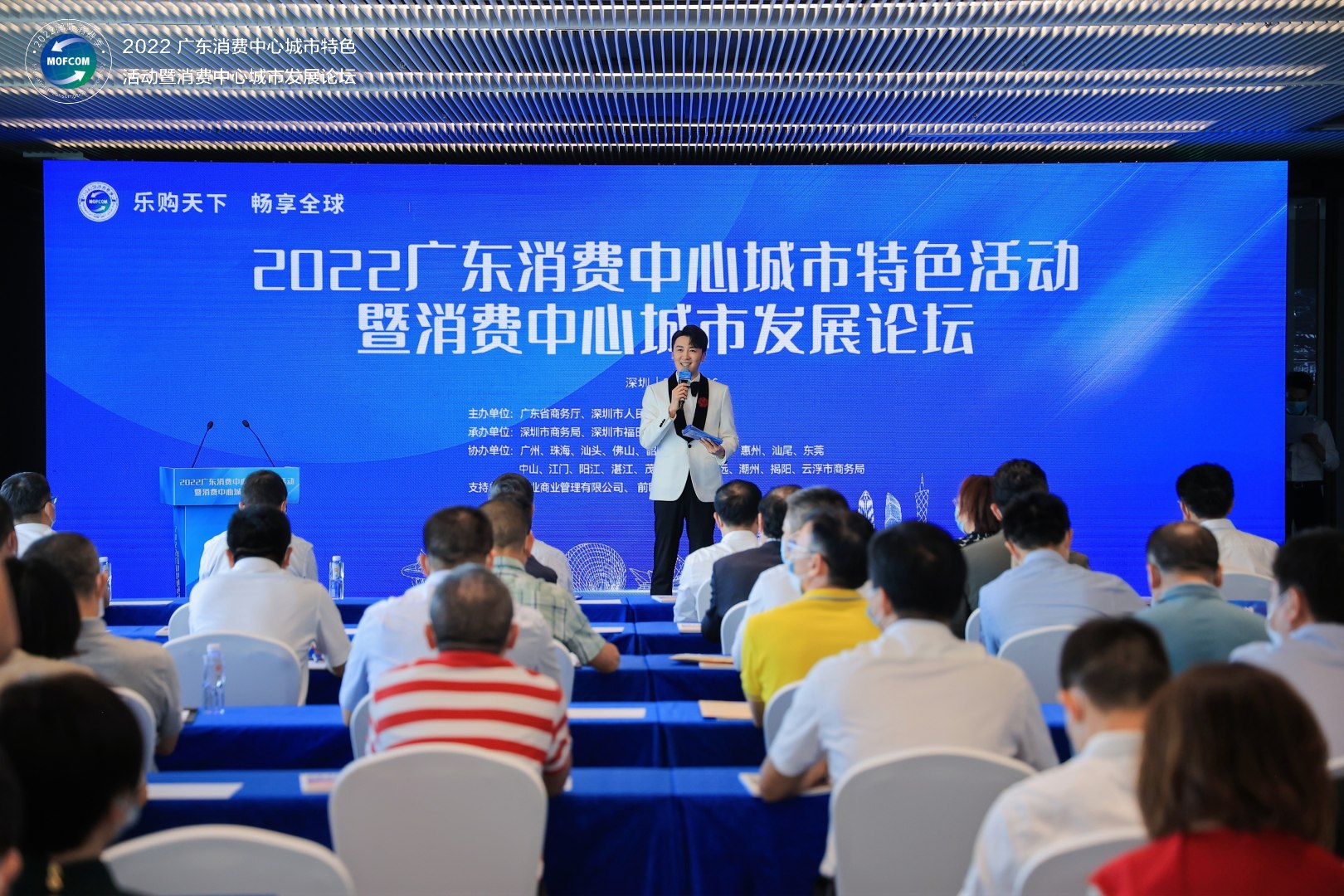
Sub-theme, focused and regionalCarry out consumption promotion activities

At the event site, Guangdong "1+1+8+N" consumption center city was announced.Fully launch a three-month special consumption activity.Cities will focus on brand consumption, platform consumption, first-store consumption and tax-free consumption, focus on the first-store launch of high-quality brands, promote the cultivation of local consumer brands, and develop business travel and cultural linkage consumption.Carry out the activities of promoting consumption in eight major consumption centers in a thematic, focused and regional way.To create a new landmark for consumption.

Among them, Guangzhou was held."Chinese Cuisine Fair" and Guangdong-Hong Kong-Macao Greater Bay Area Food Carnival in 2022With catering as the carrier, it shows the new vitality of the old city of Guangzhou and the characteristics of Guangdong-Hong Kong-Macao Greater Bay Area, and promotes the catering culture.

Held in Shenzhen"2022 Shenzhen Shopping Season" Promotes Consumption ActivitiesFocusing on the three themes of "Happy Shopping in August, Fashion Shopping in September and Brand Shopping in October", a series of theme activities were carried out in nine directions of "cultural and sports tourism, night economy, food and beverage, information consumption, Z generation consumption, business circle consumption, e-commerce live broadcast, exhibition consumption and automobile consumption", and all districts were organized to create "one district and one festival".

Zhuhai, Foshan, Dongguan, Shantou, Zhanjiang and Shaoguan launched the theme series of "Quality Consumption and Green Peer" to promote consumption.Such as "88 Foshan Summer Tesco Carnival Month", "Tesco Dongguan" consumption promotion activities, "Tesco Shantou consumption benefiting the people", Zhanjiang Binhai Cultural Tourism Consumption Festival, Shaoguan Golden Autumn Consumption Festival, etc.

The eight major cities will also focus on key categories such as automobiles, household appliances, furniture, cosmetics, clothing bags, as well as new consumption hotspots such as the first store launch, time-honored brands, local specialty restaurants, green travel, national fashion brands, local famous and special new products, and organize special events such as the global launch season, the international beauty festival, and the fashion shopping festival to further tap the consumption potential of key commodities, gather global high-quality consumption resources, accelerate the cultivation of new and upgraded consumption, and lead the way.
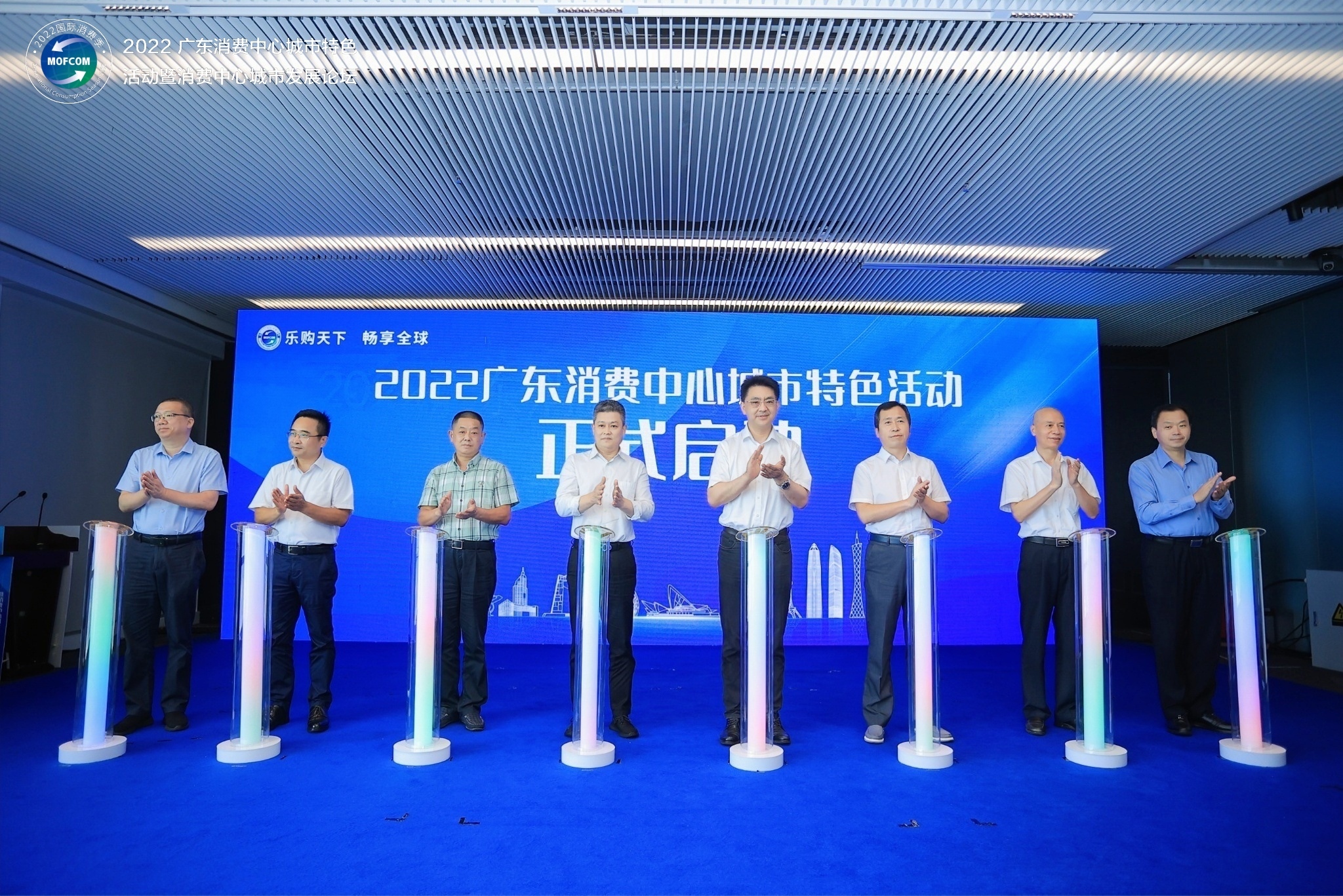
Exploration on the construction path of Guangdong’s consumption center city

In addition, a theme forum was held on the spot, inviting people fromExperts from the Ministry of Commerce of the People’s Republic of China, relevant leaders from the Guangdong Provincial Department of Commerce, the Guangzhou-Shenzhen Municipal Government and the Bureau of Commerce, and entities such as tech, dtz, retail and apparel associations, exhibitions, shopping centers and brands.Representatives of related fields, andexperts and scholarsFrom the perspectives of top-level design, urban management, industry cultivation and consumption promotion, this paper discusses the construction path of Guangdong’s consumption center city.

Luo Lianjin, member of the Party Group and first-class inspector of Guangdong Provincial Department of Commerce:

Guangdong is the largest consumption province in China, and its consumer market has a profound cultural background, which has a good foundation for cultivating and building a consumer center city. From January to July this year, the total retail sales of social consumer goods in the province was 2.54 trillion, up 1.4% year-on-year, and the growth rate was 1.6 percentage points higher than that of the whole country, and it continued to rank first in the country.

Taking the construction project of Guangdong-Hong Kong-Macao Greater Bay Area International Consumer Hub as the starting point, Guangdong has initially constructed the pattern of "1+1+6" consumer center city, which will lead Guangdong to realize consumption upgrading and expansion. Luo Lianjin put forward three requirements for this:

First, Guangzhou has taken the lead in cultivating and building an international consumption center city, which has achieved initial results. I hope that Guangzhou and Shenzhen will continue to play a leading role.Guangzhou can be different from Shanghai, Beijing and other cities, and embark on a development path of an international consumption center city with Guangzhou characteristics; Shenzhen should strive to build a new landmark of top consumption in the Bay Area and actively create an international consumption center city;

Second, Zhuhai, Shantou, Foshan, Shaoguan, Dongguan and Zhanjiang, six regional consumption centers, continue to play a leading role in radiation.: Zhuhai, Foshan and Dongguan benchmark Guangzhou as an international consumption center city, pay close attention to the implementation plan of the consumption center city, strive to build the city’s core competitiveness, and promote the upgrading and expansion of consumption; Zhanjiang and Shantou are sub-central cities in the province, and Shaoguan is a node city in the northern ecological zone, which should shoulder the historical responsibility of high-level consumption development;

Thirdly, it is hoped that other cities will integrate resources according to the development standards of consumer center cities, and make practical efforts to promote the upgrading and expansion of local consumption.
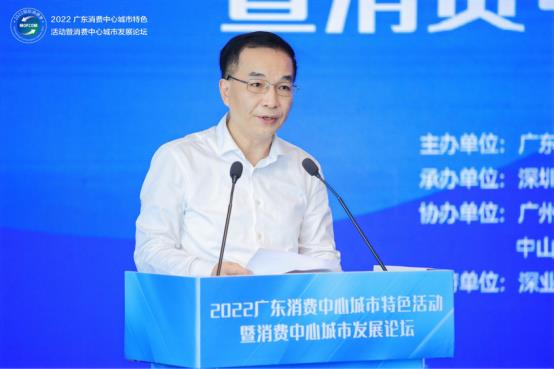
Yao Ren, Deputy Secretary General of Shenzhen Municipal People’s Government:

This year, Shenzhen has put forward 27 hard-core measures to build an international consumption center city and an international trade center city based in Greater Bay Area, radiating the whole country and facing the world, and to gather the world’s top consumption resources, cultivate innovative and leading commercial enterprises, and create a new multi-level and diversified consumption scene.

At the same time, the "Action Plan on Promoting Consumption Expansion and Quality Improvement and Creating New Consumption Demand" was formulated, which provided strong support for promoting a virtuous cycle of supply and demand in Shenzhen and promoting the formation of a strong endogenous market.
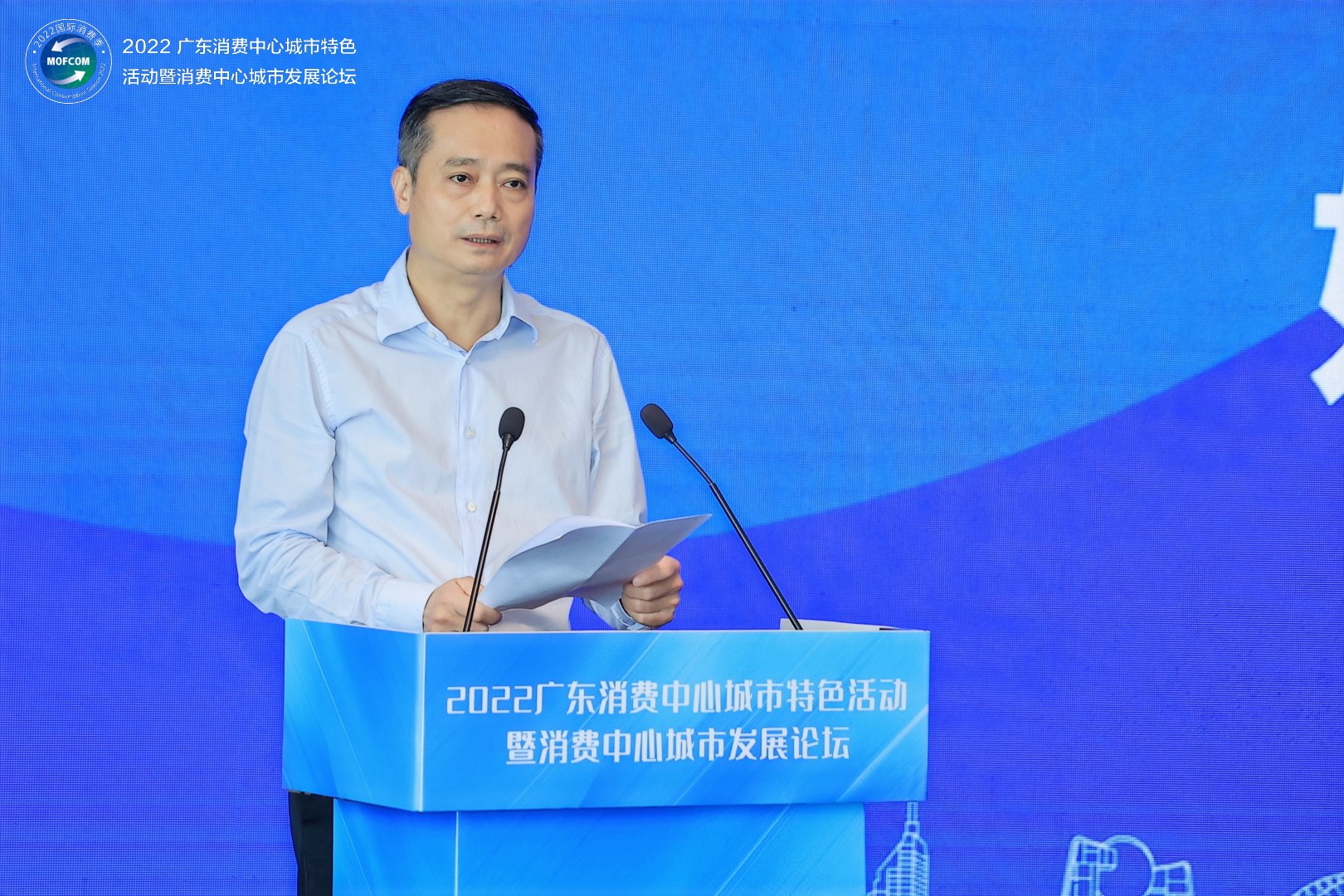
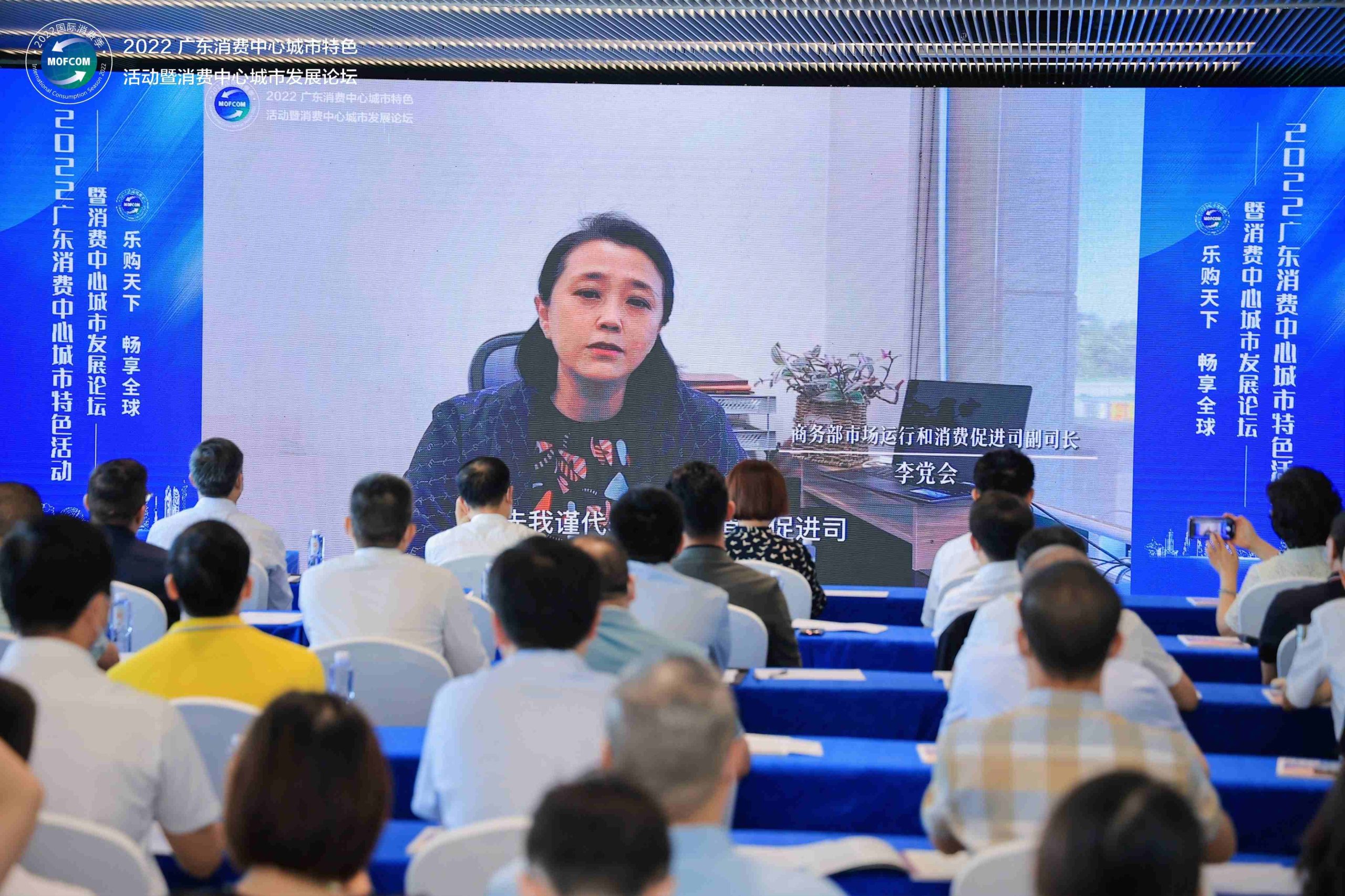
Li Danghui, the top designer of China’s international consumption center urban policy and deputy director of the Department of Market Operation and Consumption Promotion of the Ministry of Commerce;

Guangdong’s consumer market has a good foundation and a large scale, and the total retail sales of social consumer goods has remained the first in the country for many years, accounting for more than 10% of the country’s total, which has played the role of a national consumer market stabilizer.

The Ministry of Commerce, together with Guangdong Province, will resolutely implement the decision-making arrangements of the CPC Central Committee and the State Council, focus on "international", closely follow "consumption" and highlight "center".As soon as possible, Guangzhou will be built into an international consumption center city with both international style and southern Guangdong charm.
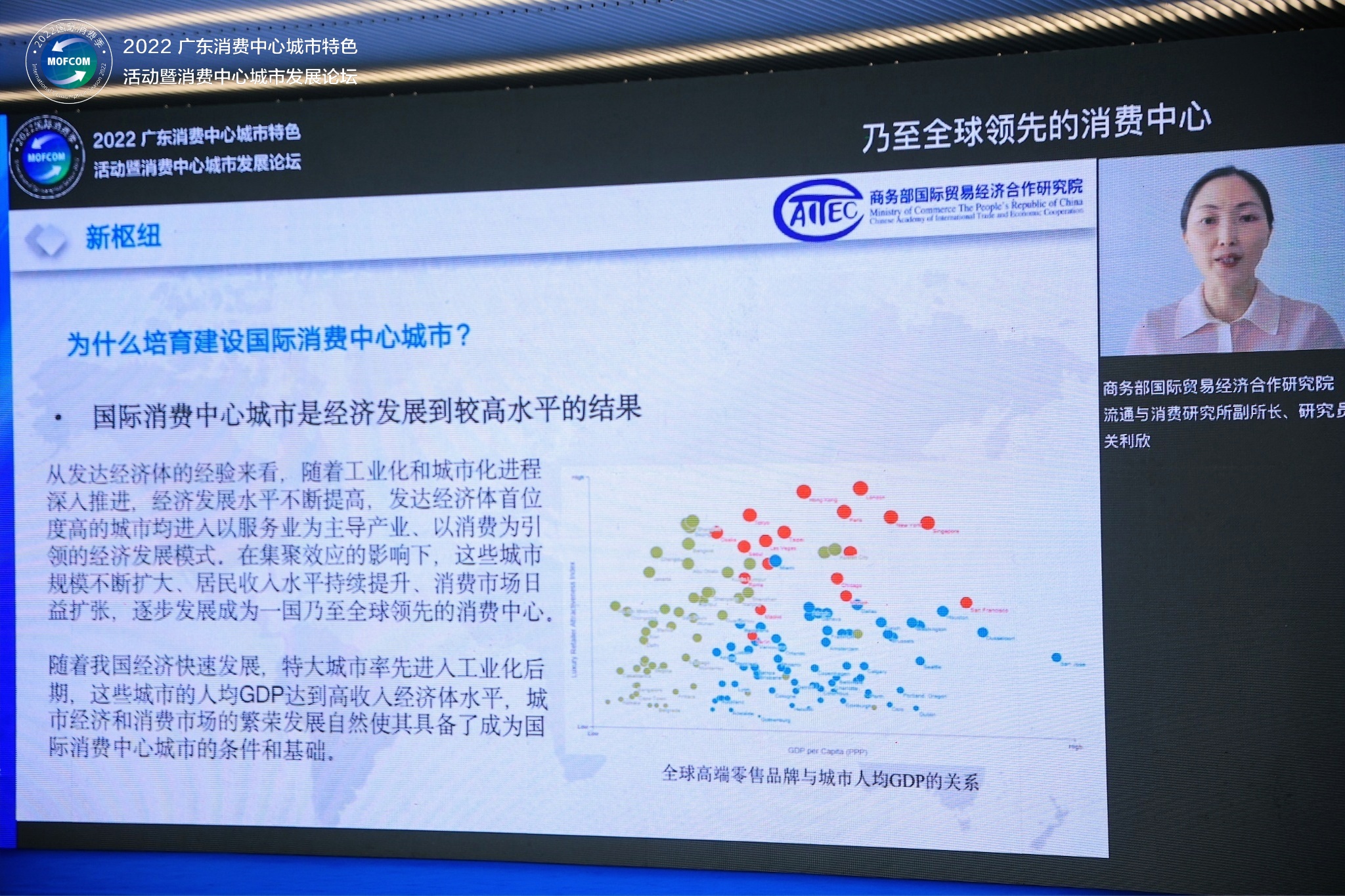
Guan Lixin, senior expert in urban policy of the International Consumer Center, deputy director and researcher of the Institute of Circulation and Consumption of the Institute of International Trade and Economic Cooperation of the Ministry of Commerce:

At present, China’s economic and social development is in a critical period of structural adjustment and power transformation. The important task of accelerating the construction of a new development pattern requires international consumer center cities to give better play to the leading and driving role of consumption.

In order to build a high-level international consumption center city, Guangdong needs to continue to make efforts to improve the level of consumption supply, improve consumption facilities and improve the consumption environment.

· Based on the international vision, gather high-quality consumption resources, focus on highlighting the characteristics of different cities, realize misplaced development, and guide local enterprises to improve the supply level of high-quality goods and services;

· Promote the opening-up of education, sports, medical care, cultural and creative services, effectively release the potential of service consumption, actively carry out international exchanges and competitions in the field of service consumption, and enhance the international visibility and influence of China services.

· Integrate innovative and diversified consumption scenarios, conform to the development trend of digital economy, enhance the convenience and intelligence level of consumption scenarios with the help of digital technology empowerment, and organically integrate new consumption with the development of smart cities.

· Improve the infrastructure construction related to consumption, optimize the convenient and efficient three-dimensional transportation network, improve the market supervision and consumer rights protection system, attach importance to building service brands made in China and China, and create an internationally competitive consumption environment.
Zhen Shiqi, Managing Director of Commercial Real Estate Department of China District, dtz, shared the theme of "The Characteristic Development Road of International Consumer Center City":
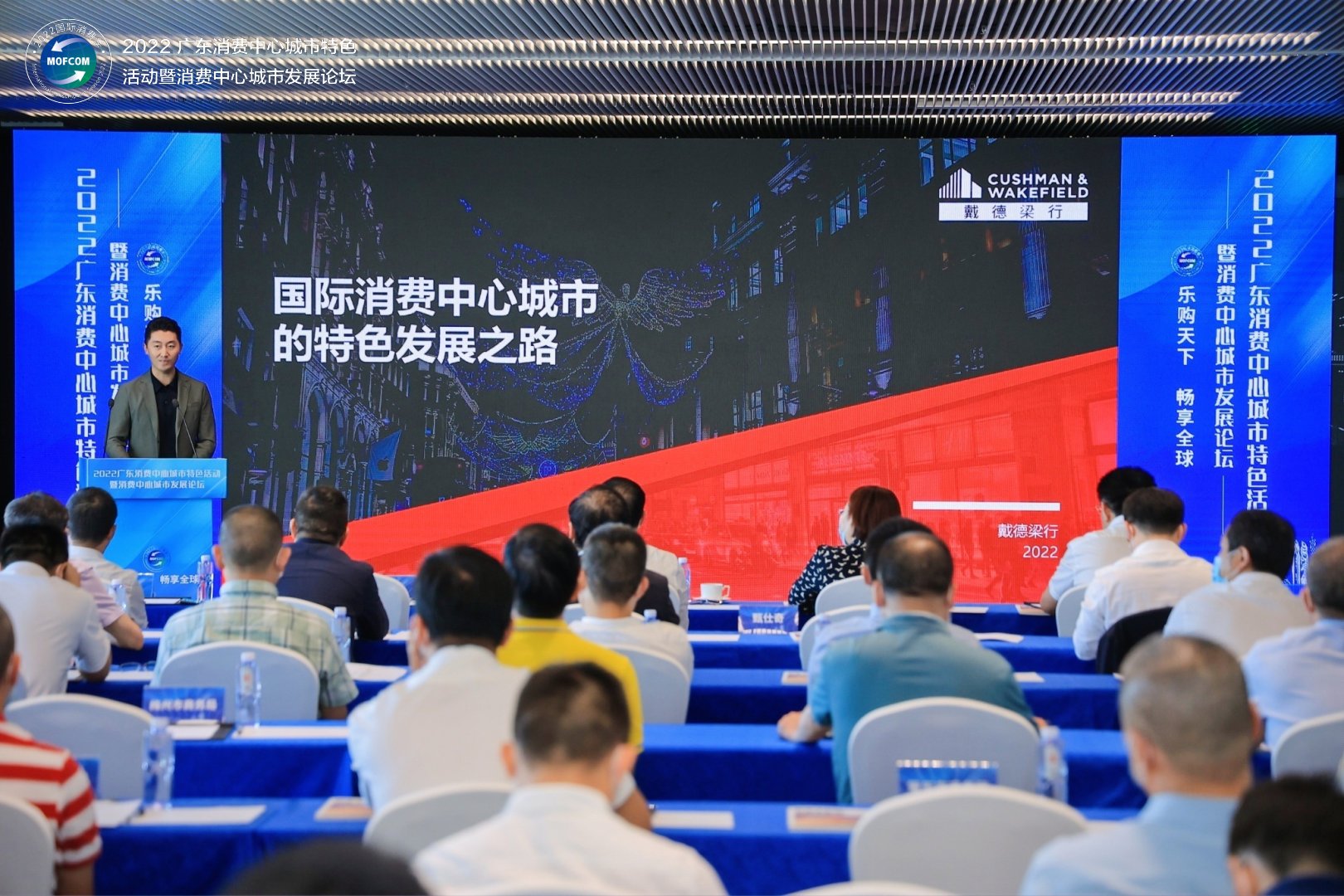
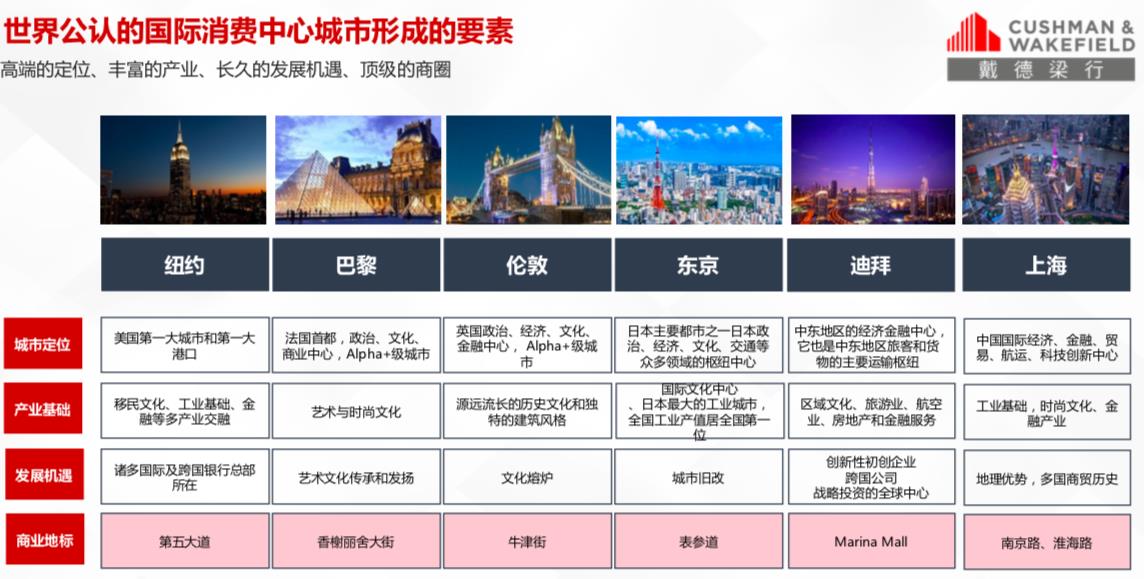
Zhen Shiqi comprehensively analyzed new york, Paris, London, Tokyo, Dubai, Shanghai and other international consumption center cities, and concluded that building an international consumption center city should have the following characteristics:

· The city where the business circle is located has a highly developed economic level and a high-level service system.

· With international and large-scale global consumer groups.

· A global commercial landmark with high content and recognition

· International cultural soft power with historical and modern compatibility and unique charm.

· Create a consumption operation platform for global aggregation and allocation of resources

· It has a legal business environment and a sophisticated consumer service system.
Focusing on the commercial and trade development level and urban positioning of many cities in Guangdong, we should pay attention to tapping the characteristic advantages of each city, coordinate the development of "1+1+6" urban consumption, and build consumption centers with different echelon distribution and mutual promotion.

At the same time, he mentioned that to achieve a great leap in Guangdong’s future consumption development, we must grasp three goals, including the transformation of inefficient consumer cities, the upgrading of characteristic consumer cities and the excavation of potential consumer cities.

Wu Chuankun, Chairman of Win tech and Vice President of China Business Federation, brought the theme of Guangdong Urban Business Analysis Report to share:

Wu Chuankun mainly shows the commercial development level of Guangdong’s consumer center cities from the data level, as well as the development differences with other key provinces and cities in China.
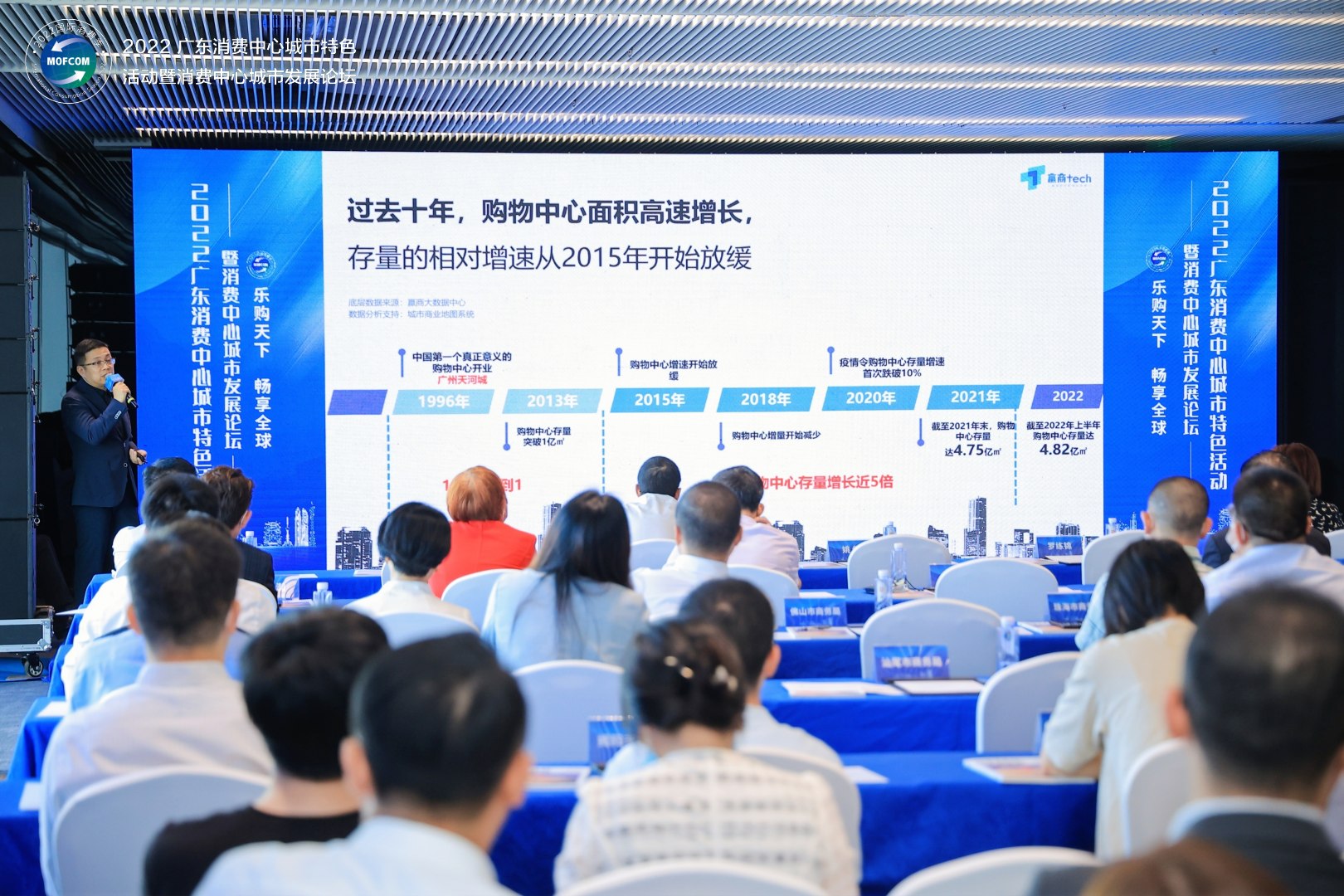
Judging from the level of commercial developmentGuangdong’s commercial stock ranks first in the country, and its commercial development base is excellent. However, judging from the incremental performance of business in the next three years, Jiangsu will surpass Guangdong and become the first in the country.

From the perspective of commercial development structureGuangzhou, Shenzhen, Foshan, Dongguan, Huizhou and Zhongshan in Guangdong Province were shortlisted in the national urban commercial power index TOP50, but compared with Jiangsu Province, 13 cities in Guangdong Province were shortlisted, indicating that there is still room for improvement in Guangdong Province.

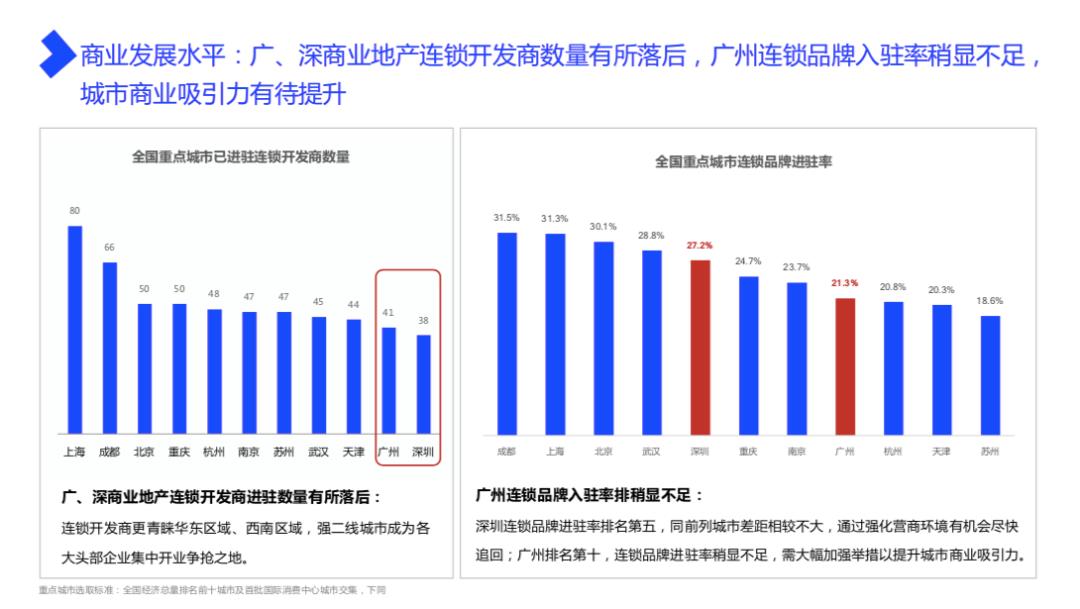
The stationing data of chain developers and chain brands reflect the attractiveness of urban commerce to some extent. Chain developers prefer East China and Southwest China, and the number of chain developers of Guangzhou-Shenzhen commercial real estate is relatively backward.

The occupancy rate of chain brands in Shenzhen ranks fifth in China, which is not far from Chengdu, Shanghai, Beijing and Wuhan. However, Guangzhou obviously lags behind the above cities, with a gap of about 10%, ranking tenth in China. Measures should be greatly strengthened to enhance the commercial attractiveness of the city.
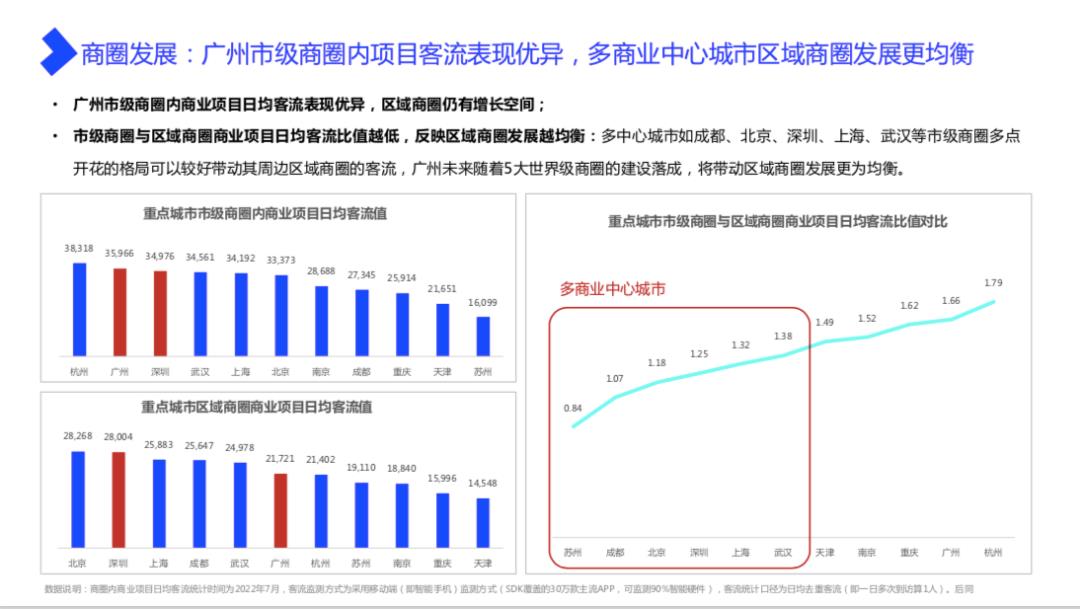
From the analysis of commercial development patternShanghai, Beijing, Shenzhen, Suzhou, Wuhan and Chengdu have formed a multi-center development pattern; Guangzhou, Chongqing, Hangzhou, Tianjin and Nanjing are still in the process of developing from single center to multi-center.
Focusing on six regional consumption center cities, Zhuhai, Shaoguan and Foshan have strong development potential in the future increment of shopping centers;
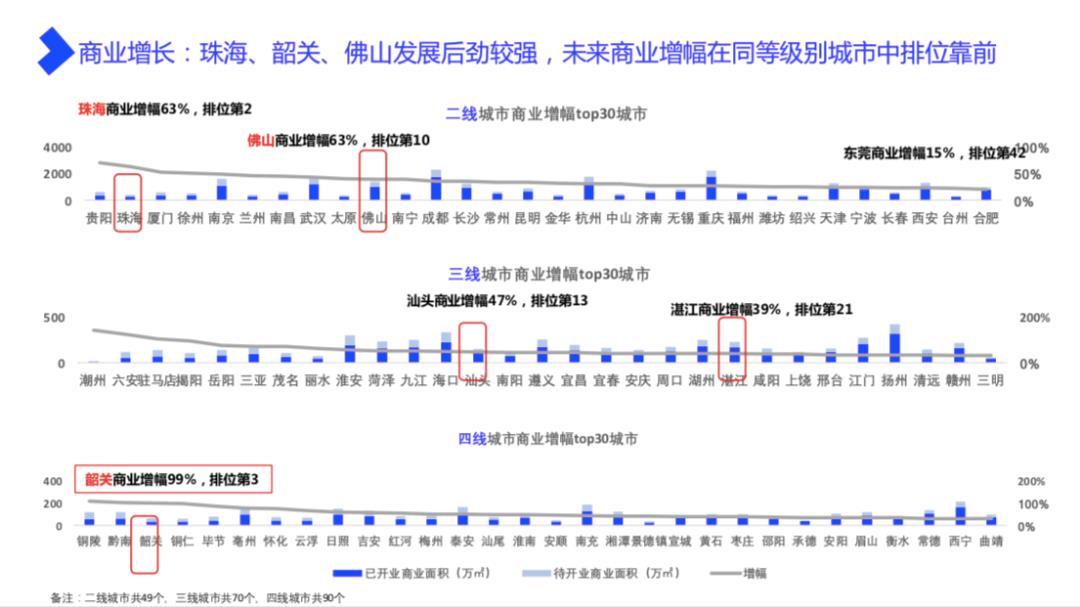
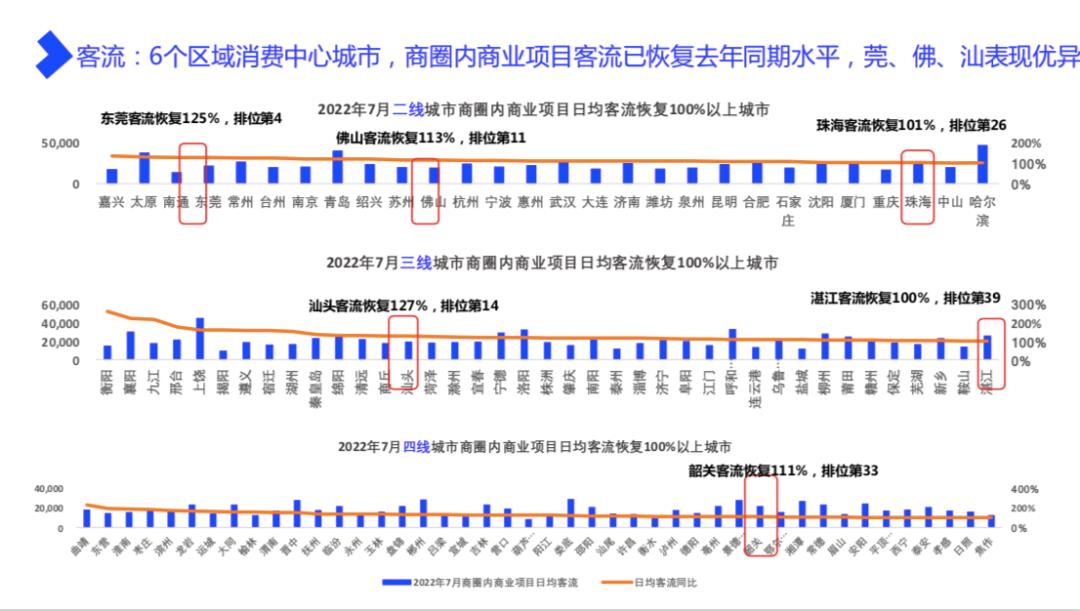
Judging from the situation of passenger flow recovery, passenger flow recovery can be regarded as an important prerequisite for the recovery of sales in shopping malls. At present, the passenger flow of commercial projects in the business circle has returned to the same level of last year, and the passenger flow in Dongguan, Foshan and Shantou has performed well, which shows that the dark moment of physical commerce has passed.
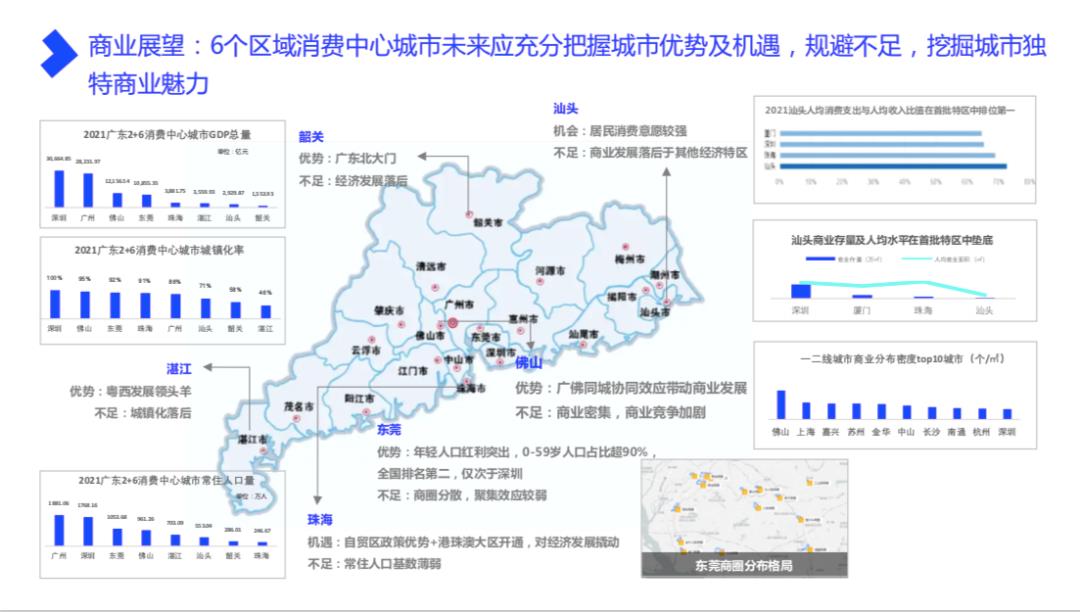
Looking forward to the future, how can Foshan enlarge the benefits of the same city as Guangzhou and Foshan, and how can Shantou make up for the shortage of commercial supply? How does Zhanjiang avoid severe commercial homogenization? Zhuhai has a large commercial development space, but how to solve the problem of insufficient permanent population? The young population in Dongguan is relatively high, second only to Shenzhen, but the business circle is scattered …

Generally speaking,In the future, six regional consumption center cities should fully grasp the advantages and opportunities of the city, avoid the shortcomings and tap the unique commercial charm of the city.
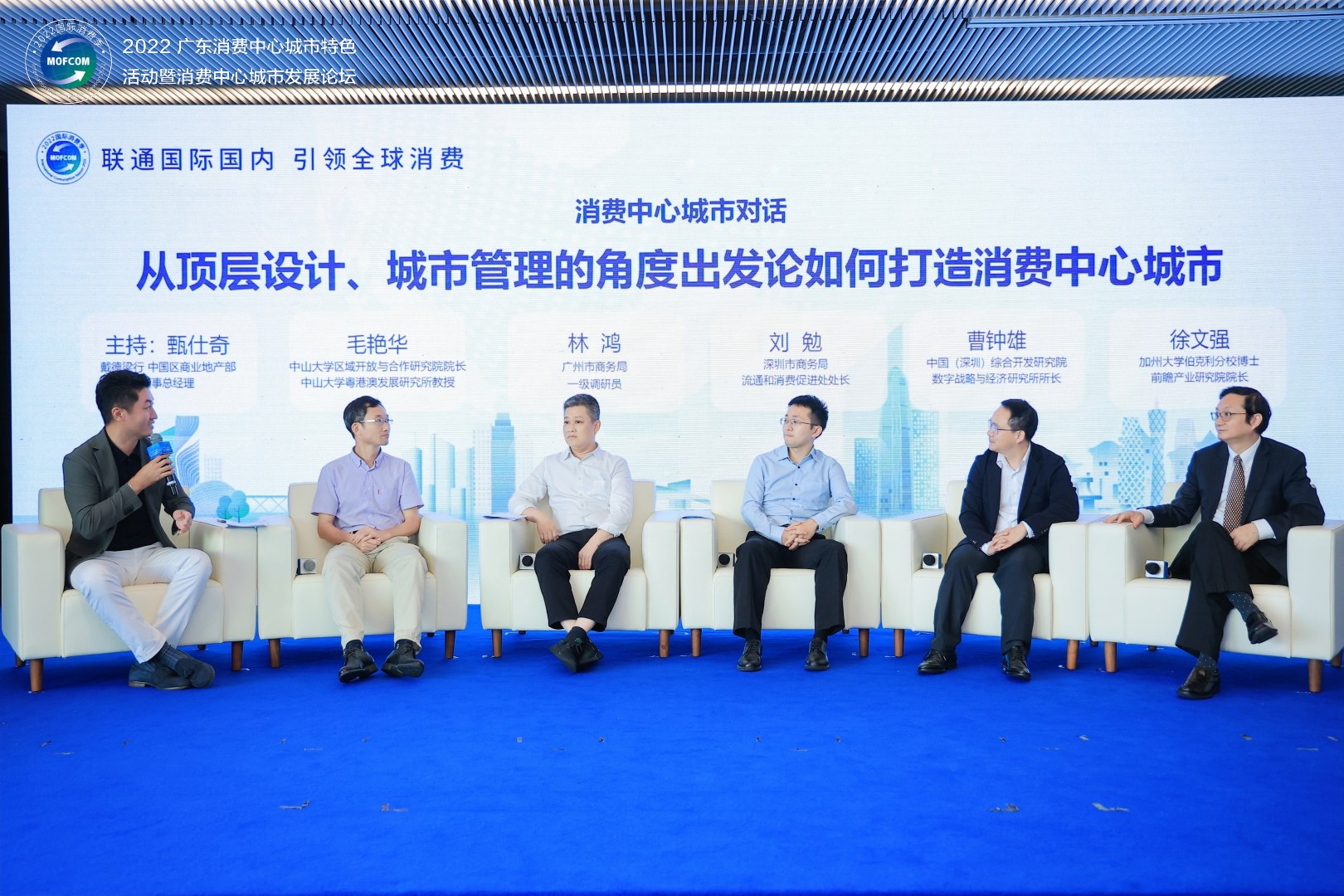
//High-end Dialogue 1: From the perspective of top-level design and urban management, discuss how to build a consumer center city.

Guest host:Zhen Shiqi, Managing Director of Commercial Real Estate Department of China District, dtz

Dialogue guests:

Mao Yanhua, Dean of the Institute of Regional Opening and Cooperation of Sun Yat-sen University and Professor of the Institute of Guangdong, Hong Kong and Macao Development of Sun Yat-sen University.

Lin Hong, a first-class researcher of Guangzhou Municipal Bureau of Commerce.

Liu Mian, Director of Circulation and Consumption Promotion Department of Shenzhen Municipal Bureau of Commerce

Cao Zhongxiong, Director of Institute of Digital Strategy and Economics, China (Shenzhen) Comprehensive Development Research Institute.

Xu Wenqiang, Ph.D. and Dean of Prospective Industry Research Institute, University of California, Berkeley.
Mao Yanhua, Dean of the Institute of Regional Opening and Cooperation of Sun Yat-sen University and Professor of the Institute of Guangdong, Hong Kong and Macao Development of Sun Yat-sen University.

Consumption is the inevitable trend of economic development. As a big economic province, it is very important for Guangdong to play a leading role in consumption and how to keep consumption at home. We should think about how to improve the quality of goods and services and stimulate consumption power.

Lin Hong, a first-class researcher of Guangzhou Municipal Bureau of Commerce.

As a Millennium business capital, Guangzhou has a good brand and story in the traditional service field, and its industry, service and traffic still have its advantages and characteristics in the whole country.

From the consumer market,Guangzhou should build an industrial consumption systemFor example, in the automobile industry, if the city is taken as a unit, Guangzhou’s total automobile output ranks first in the country; The daily use of beauty cosmetics has reached a scale of over 100 billion yuan … Guangzhou has promoted the construction of the consumption system of "consumption+fashion" and "consumption+car" from the government level in combination with the actual situation of the city.

Guangzhou is a hub city, and both Guangzhou South Railway Station and the number of urban tourists rank among the top in the country. Based on this,Guangzhou actively promotes the creation of tourist destinations.And create 100 punch-in attractions and other actions.In order to improve the retention of traffic and promote consumption growth.

On the service level, Guangzhou has the first five-star hotel, the first commercial complex, and the dual titles of "Chinese Food Capital" and "International Food Capital".Guangzhou constantly builds and consolidates the city’s service system.To promote the improvement of service-oriented consumption.
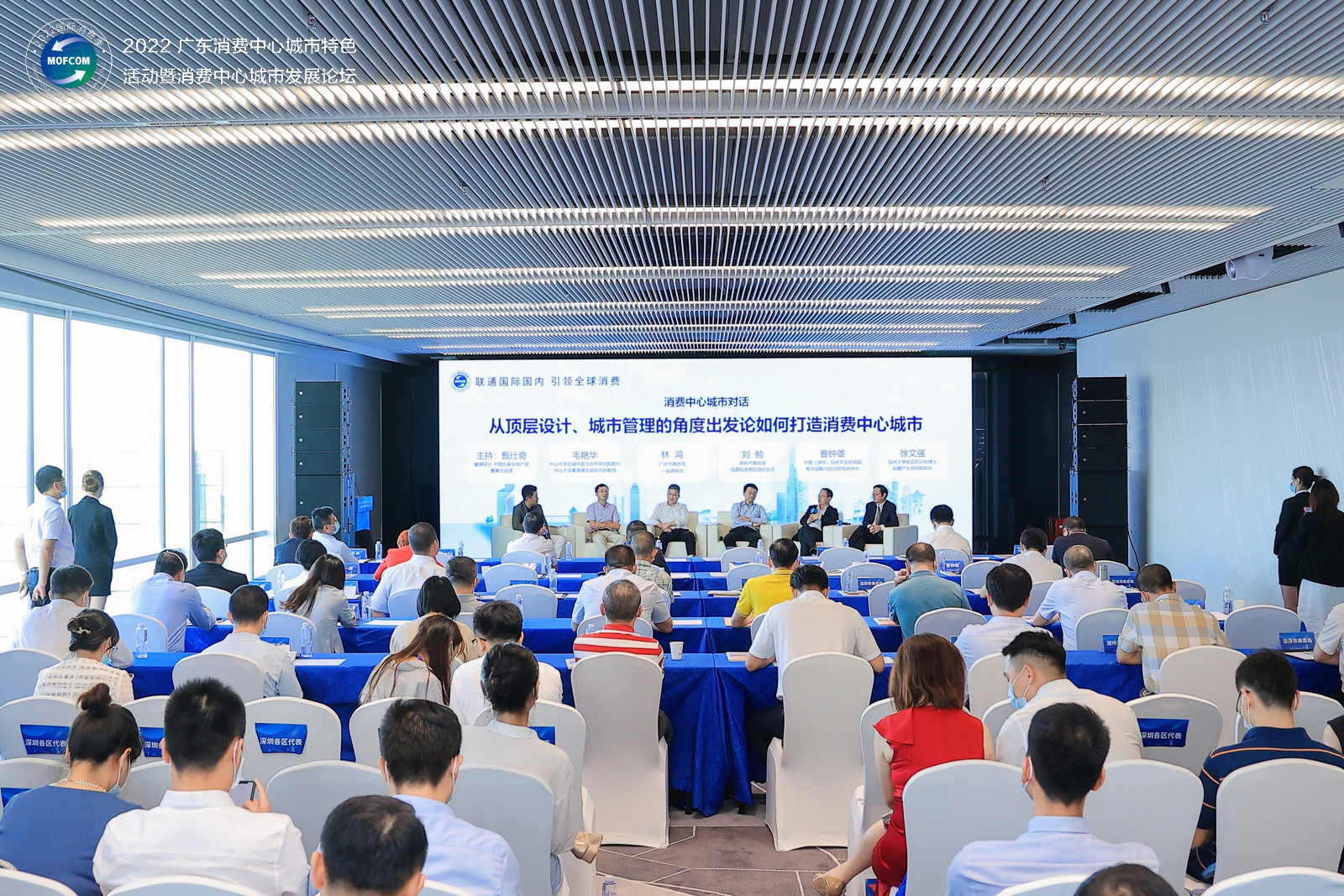
Liu Mian, Director of Circulation and Consumption Promotion Department of Shenzhen Municipal Bureau of Commerce

In the past, for Shenzhen, the labels that people thought of might be innovation, science and technology, industry, finance, etc., and few people thought of consumption, because this city is a place to start a business and make money, not a place to spend money.

But in recent years, this situation has changed obviously.

There are mainly the following reasons:

· Adequate supply:Shenzhen has a good foundation for industrial science and technology innovation, and has cultivated many local brands, including high-end women’s wear, high-end watches, glasses, gold jewelry, etc. In the field of consumer electronics, Huawei, Glory and DJI, as Shenzhen brands, have grown into excellent brands at home and abroad.

Strong demand:Shenzhen is a young city, and young people’s consumption concept has changed greatly. They don’t have to buy a car, buy a house or get married, but they must be good to themselves, which has spawned a self-respecting economy. In addition, data from third-party platforms show that Shenzhen’s late-night consumption ranks first in the country.

On the one hand, this kind of consumption power needs higher income, on the other hand, it is a strong desire to buy.

Commercial carriers are fully supplied and distinctive;The stock of commercial complexes in Shenzhen ranks among the top in China, and commercial carriers with urban characteristics provide consumers with rich commercial experiences.

Next, there will be some special commercial carriers, such as the largest legoland in China and the World of Ice and Snow, which are all under construction, and will further lead the consumption upgrade in the future.

On the whole, Shenzhen has great consumption potential. In order to promote the construction of Shenzhen as an international consumption center city, Shenzhen has also set several development directions: a global center of consumption innovation, an important residence of international brands, a world window made in China, a fashion capital that leads the trend, etc. It is hoped that through these positioning, the consumption formats and brands of the whole city will be further enriched, local consumption will be retained, and foreign consumption will be attracted.

Cao Zhongxiong, Director of Institute of Digital Strategy and Economics, China (Shenzhen) Comprehensive Development Research Institute.

In order to play a leading role in building an international consumption center city, Guangzhou and Shenzhen should first find the characteristics of the city and guide the new consumption system and culture.

Xu Wenqiang, Ph.D. and Dean of Prospective Industry Research Institute, University of California, Berkeley.

Drawing lessons from the construction experience of Paris, new york and other international consumption centers, we can see that they have created different types of platform economy such as NBA, Broadway or other events, and attracted many high-end talents from all over the world.

Only some people have consumption, so to build an international consumption center city, we should create an open and inclusive environment and set up a more flexible mechanism system from the top design, such as reducing the restrictions on foreign personnel exchanges to a certain extent, such as visa-free 5-day tour, tax exemption and tax refund policy for shopping consumption, etc.

//The second theme: From the perspective of industry cultivation and consumption promotion, discuss how to build a consumption center city.

Guest host:Wu Chuankun, Chairman of Win tech and Vice President of China Business Federation

Dialogue guests:

Chief Executive Officer of Cuihua Group (China District) Tang Yihan

Liu Songping, President of Guangdong Exhibition Enterprise Association and Vice President of China Exhibition Economic Research Association.

Wen Danfeng, Dean of Guangdong Global Industrial Innovation Research Institute and Chief Data Officer of Guangdong Garment Association

Xie Yongming, Vice President of Shenzhen Retail Business Association

Ou Wei, General Manager of Shenye Management Co., Ltd.
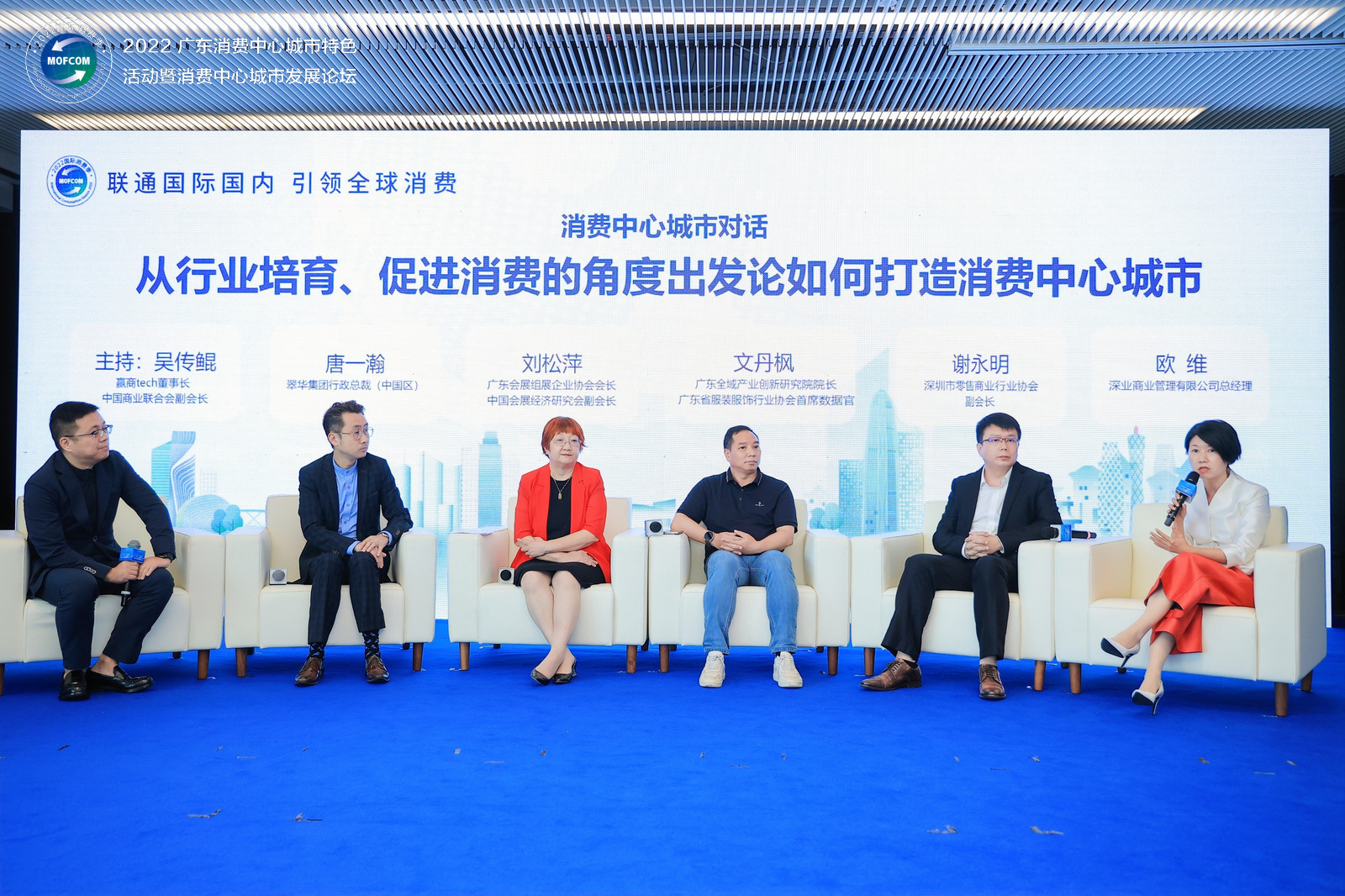
Chief Executive Officer of Cuihua Group (China District) Tang Yihan

If we only tap the time-honored brand culture, we may not be able to catch the attention of young people for a long time. Building a consumption center city is actually the integration of old and new cultures, so that culture can be passed on.

Take Cuihua as an example. On the surface, it is a catering brand, but it actually carries Hong Kong’s characteristic catering culture and consumption culture. If we continue to inherit the culture and produce richer content, the brand vitality will last forever.

Liu Songping, President of Guangdong Exhibition Enterprise Association and Vice President of China Exhibition Economic Research Association.

The exhibition will be the tipping point of a consumer goods market to build and cultivate a consumption center city. Because the basic feature of exhibition is the gathering of people, the food, shelter and transportation it produces directly drive consumption, which reflects the business environment and consumption power of the city. Therefore, it is necessary to build a consumption center city with distinctive exhibition activities.

Dean of Guangdong Global Industrial Innovation Research Institute and chief data officer Wendanfeng of Guangdong Garment Association.

The consumption center city is inseparable from the fashion and manufacturing industries.

The construction of Guangdong’s consumer center city is an opportunity for the clothing industry, which will promote the reform and adjustment of the supply side of the clothing industry and promote the more integrated development of industry and consumption, thus helping to build a consumer center city.
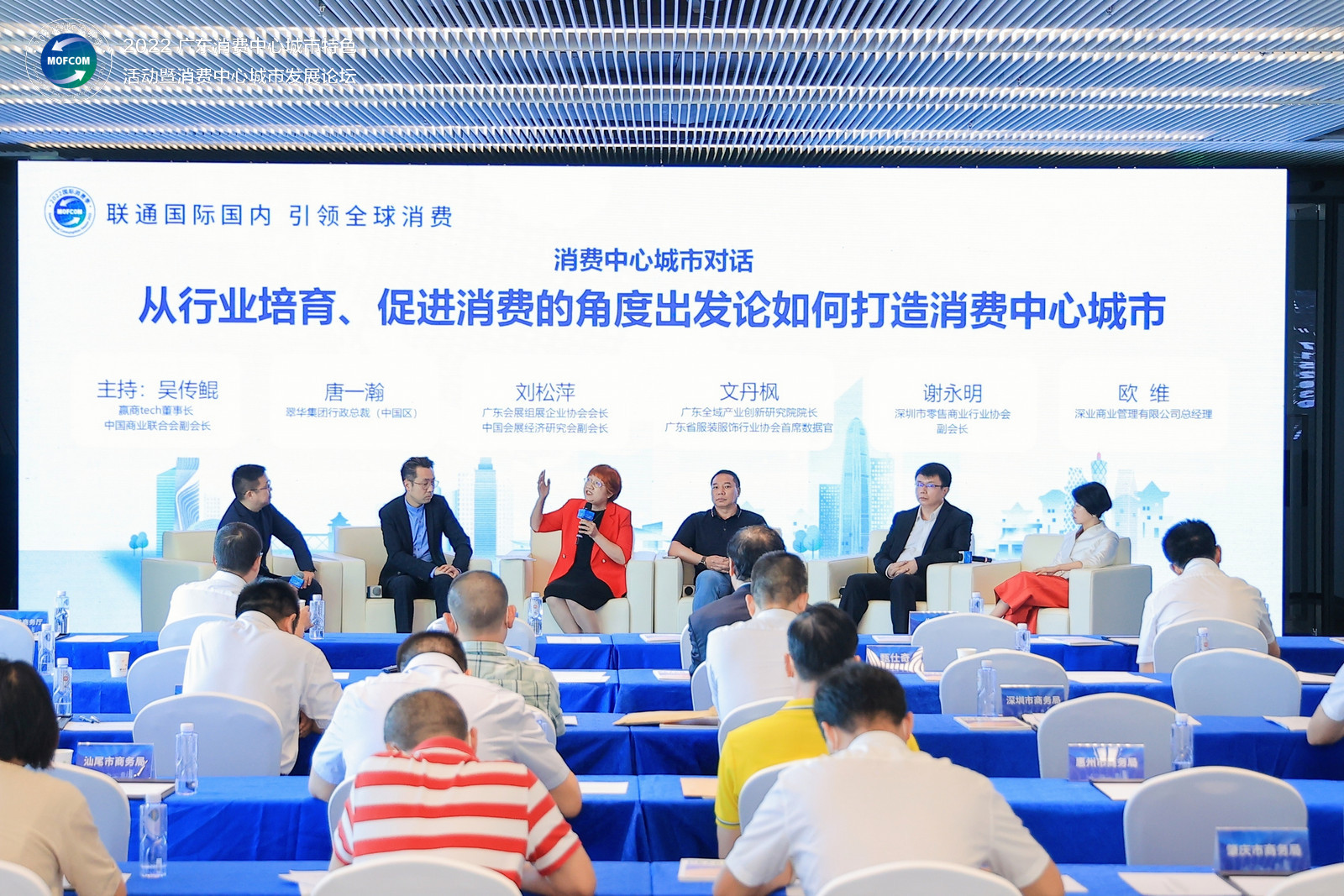
?

Xie Yongming, Vice President of Shenzhen Retail Business Association

In order to build Guangdong into a consumption center city, the core is to bravely propose to build China’s own high-end consumption display window, so as to better show it to the world in Guangdong cities and lead future consumption. For example, Shenzhen’s Huawei and BYD (002594) are all leading brands in the world.

The second is to create a smart business circle, that is, the application of technology in consumption. For example, on an APP, you can display all the goods in the whole business circle. Consumers only need to input the demand label, so that they can recommend goods in a targeted manner, so that technology can be better presented in the retail industry and serve consumers.

Ou Wei, General Manager of Shenye Management Co., Ltd.

For building a consumption center city, the consumption platform is very important. Landmark projects and consumption scenes can attract passengers to gather and stay.

Therefore, when planning and building commercial projects, we should not only consider the benefits of enterprises themselves, but also consider the relationship between projects and cities from the perspective of social responsibility, so that the traditions and characteristics of cities can be integrated into commercial projects to help build a consumption center city.

(Editor: Zhou Wenkai)
Fertility assessment helps women better understand their fertility potential.

Authors: Deputy Chief Physician Zhu Xiaodan, Department of Obstetrics and Gynecology, Putuo Hospital, Shanghai University of Traditional Chinese Medicine.

At present, the global fertility problems are increasing day by day, and the overall fertility of women is on the decline. Women are facing various pressures in modern society, including occupational pressure, family pressure, social expectations, and the unhealthy lifestyle that follows, which makes the fertility of contemporary women decline more and more "younger". At present, the incidence of infertility is as high as 10%~18%. In 2023, the birth rate in China was as low as 6.4‰.

National birth rate

In the reproductive endocrinology clinic, patients often ask: How is my fertility? Can you still be born? Faced with such a question, today, let’s talk about this topic.

As we all know, to complete a successful pregnancy, women need the cooperation of the whole reproductive system and all organs of the whole body. Therefore, the evaluation of female fertility is divided into three parts: the first part is the evaluation of ovarian reserve function, the second part is the evaluation of the structure and function of uterus and fallopian tube, and the third part is the evaluation of general state.

First, the ovarian reserve function

The ovarian reserve function of women refers to the quantity and quality of eggs, that is, the "inventory" of follicles with growth and development functions. The number of follicles in women has been determined at birth and is non-renewable. With the increase of age and the progress of menstrual cycle, the number of eggs gradually decreases. So how do we evaluate how much "inventory" there is in the ovaries?

1. Age

Age is the primary factor to evaluate fertility, and the best reproductive age for women is 23~32 years old. With the increase of age, fertility gradually decreases, pregnancy rate and live birth rate decrease, and abortion rate increases. With the increase of age, ovarian function declines irreversibly, and the number of follicles and the quality of eggs decrease. Age-related abnormal vascularization, oxidative stress and free radical imbalance in the ovary will lead to the decline of oocyte quality, which will lead to fertilization failure or abnormal embryo development.

The picture comes from the Internet.

2. Basic follicle stimulating hormone (bFSH)

BFSH is the level of serum FSH on the second to fourth day of menstruation, and it is one of the indexes to evaluate ovarian reserve function. The main reasons for the increase of bFSH level are the aging, the decline of ovarian function, the decrease of E2 secretion, the weakening of negative feedback on hypothalamus-pituitary-ovarian axis, and the subsequent increase of FSH. When the serum level of bFSH is higher than 10u/L, the ovarian reserve function is decreased, and when the serum level of bFSH is higher than 18u/L, the live birth rate is almost zero.

3. Basic estradiol (bE2)

BE2 refers to the level of serum E2 on the 2nd to 4th day of menstrual cycle, which can be used as an index to evaluate ovarian reserve function. When the bE2 value is more than 74.9 pg/ml (274.134 pmol/L), the ovarian function is decreased or the pregnancy outcome is poor when in vitro fertilization (IVF) is performed, and the number of embryos obtained is small.

4. FSH/LH (follicle stimulating hormone/luteinizing hormone) ratio

FSH/LH ratio can be used as an index to reflect ovarian function, and can also be used as a sign of ovarian response to gonadotropin to predict pregnancy outcome. When FSH/LH > 2, it is suggested that the ovary may have a bad reaction to gonadotropin in assisted reproductive technology. When FSH/LH > 3.6, the ovarian function is obviously decreased, and the cancellation rate of IVF ovulation cycle is high.

5. Anti-Miller hormone (AMH)

AMH is mainly produced by primary follicles, preantral follicles, sinus follicles, etc. It regulates the growth and development of follicles and is not regulated by hypothalamus-pituitary-ovary axis. As a reliable index of ovarian reserve function, it can be detected on any day of menstrual cycle. Serum AMH concentration was negatively correlated with age. AMH value reaches its peak in adulthood (about 25 years old), generally drops significantly after 36 years old, and approaches zero when approaching menopause.

6. Inhibin B(INH-B)

INH-B appears from the pre-antral follicular phase and is regulated by FSH. INH-B level, as a direct index to predict ovarian reserve function, reflects ovarian reserve. On the third day of menstruation, the blood INH-B < 45 ng/L indicates that ovarian function is decreased.

7. Sinus follicle count (AFC) and ovarian volume

AFC, ovarian volume and ovarian interstitial blood flow parameters can be used as evaluation indexes of ovarian reserve function and responsiveness. AFC is significantly correlated with age and basic hormones. With age, the number of follicles decreases exponentially. Ovarian volume can reflect the number of follicles and the situation of ovarian reserve pool from another angle. With the increase of age, ovarian function declines and ovarian volume shrinks. The most commonly used parameters of ovarian stromal blood flow are the peak velocity of ovarian stromal blood flow (PSV) and resistance index (RI). High PSV and/or low RI indicate that the ovarian interstitial blood supply is abundant and the ovary responds well to gonadotropin.

Second, the evaluation of the structure and function of reproductive tract

Because of the special anatomical structure and physiological function of female reproductive tract, the evaluation of reproductive tract structure and function is also an important link in fertility evaluation, including vagina, cervix, uterus, fallopian tube and pelvic cavity.

1. Detection of vaginal microecology

Female reproductive tract flora is closely related to every step of ovulation, sperm transport, fertilized egg implantation, pregnancy and delivery. Reproductive tract infection of women of childbearing age affects their reproductive health, damages their reproductive function and increases the risk of infertility.

2. Detection of cervical lesions

Cervical diseases tend to be younger, which are closely related to fertility and pregnancy outcome. Regular gynecological physical examination, cervical liquid-based thin-layer cytology (TCT) and human papillomavirus (HPV) screening should be conducted to detect cervical diseases as soon as possible.

3. Detection of uterine abnormalities

Non-invasive ultrasound, such as hysteromyoma and endometrial polyp, is the most widely used examination method to evaluate the receptivity of uterus and endometrium, and to evaluate the shape, thickness, volume, peristalsis wave, uterine artery and hemodynamic parameters of endometrium. Hysteroscopy is the gold standard for the diagnosis of endometrial lesions, which can accurately identify cervical lesions, intrauterine lesions, abnormal endometrial morphology and abnormal tubal opening through endoscopy. Endometrial biopsy can also be performed. At present, there are cytokines, various receptors, endometrial receptivity chips and other detection methods to evaluate endometrial receptivity, and the research on endometrial receptivity is constantly expanding.

4. Tubal patency test

Including salpingostomy, hysterosalpingography/contrast-enhanced ultrasound and laparoscopic salpingostomy. At present, hysterosalpingography has become a research hotspot with its unique advantages (real-time dynamic, visualization and no radiation), and has gradually become the first choice for tubal patency examination. Liquid drainage has some shortcomings, such as invisibility, blindness and great difference. X-ray radiography, as a traditional method of tubal patency examination, mainly has the disadvantages of adverse reaction of contrast agent and radiation damage. Laparoscopic salpingostomy is the "gold standard", but it is not the first choice for the time being because of invasion, hospitalization, high cost, surgery and anesthesia.

The picture comes from the Internet.

5. Detection of pelvic factors

Pelvic diseases are closely related to female fertility, such as pelvic endometriosis, pelvic tuberculosis, pelvic adhesion, tubal diseases, hysteromyoma, ovarian tumors and pelvic inflammatory diseases. Laparoscopic surgery can find and diagnose abnormal pelvic conditions in time. For infertility caused by fallopian tube factors or uterine cavity factors, hysteroscopy combined with laparoscopy can treat pelvic cavity, fallopian tube and uterine cavity diseases accordingly, which has important clinical value for female fertility evaluation, diagnosis and treatment.

6. Female reproductive tract dysplasia

Abnormal development of female reproductive tract includes abnormal development of vagina, cervix, uterine body and fallopian tube, with or without abnormalities of ovary and urinary system. The combination of pelvic ultrasound and MRI examination is the best examination method for reproductive tract dysplasia.

Third, the general state assessment

In terms of systemic diseases, we should evaluate whether there are diseases that affect fertility or are not suitable for fertility, such as thyroid diseases, familial genetic diseases, blood system diseases, cardiopulmonary diseases and tumors.

1. Thyroid diseases

Abnormal thyroid function can lead to infertility and poor pregnancy outcome, so it is suggested that women with family planning should monitor thyroid function. Clinical hyperthyroidism can lead to abortion, premature delivery and thyroid crisis, and timely treatment can significantly reduce these risks; Infertile women with subclinical hypothyroidism should be treated with levothyroxine (LT4).

2. Hereditary diseases

According to the etiology, it can be divided into monogenic diseases, polygenic diseases, chromosomal diseases, mitochondrial genetic diseases and somatic genetic diseases, which have the characteristics of congenital, lifelong and familial. It is suggested that couples with rare diseases or couples who have given birth to rare diseases should have genetic testing and genetic counseling, reproductive risk assessment and guide reproductive decisions. The genetic diagnosis (PGD) before embryo implantation was provided after the pathogenic gene locus and genetic mode of the family were clarified.

3. Other general conditions

Nutritional status is a very important factor in regulating reproductive process, which is closely related to female reproductive function. For example, obesity and malnutrition have adverse effects on internal environment, egg quality and embryo development. In addition, mental state, living environment and systemic factors also need comprehensive consideration. Whether a woman’s whole system can withstand pregnancy is also the concern of fertility evaluation, including whether she is complicated with diabetes, hypertension, heart disease and tumor.

4. Who needs fertility assessment?

1. Couples who have been pregnant for more than 1 year without pregnancy;

2. People who have had many bad pregnancies in the past;

3. People who have had multiple abortions or ectopic pregnancy in the past;

4. Women of childbearing age with less menstrual flow, irregular menstrual cycle and dysmenorrhea;

5. Obese or thin people (BMI>24 or BMI<18.5);

6. White-collar workers who stay up late and work overtime for a long time;

7. People who use computers and mobile phones for a long time to work in a radiation environment;

8. People with smoking, drinking, drug addiction and other habits.

In a word, fertility assessment can help women understand their fertility potential and possible fertility problems. In fact, whether you have the desire to have children at present or not, regular fertility assessment can help you plan your birth plan reasonably, receive corresponding medical help in time, and don’t leave regrets for your life!

Central Meteorological Observatory: Heavy rain and strong convection warning are all in full swing, and the high temperature tolerance in Huanghuai and other places in North China is full.

  Cctv newsAccording to the Central Meteorological Observatory, yesterday, heavy rainfall mainly occurred in eastern Sichuan, northwestern and southwestern Shaanxi, central Shanxi, northeastern Shandong, central Guangxi, eastern Guangdong and other places, including Chengdu, Mianyang and Guangyuan in Sichuan, Hanzhong in Shaanxi, Baise in Guangxi and Shanwei in Guangdong. Thunderstorms or hailstorms occurred in southern Ningxia, north-central Shaanxi, western Shanxi, and central and eastern Shandong. It is estimated that there will be heavy rain or rainstorm in the southwestern Shaanxi, eastern Sichuan Basin, Jianghan, Jianghuai, northern Jiangnan, eastern Huanghuai, eastern North China, southern Liaoning and northern Heilongjiang on the 28th to 30th, with local heavy rain accompanied by obvious strong convective weather. The Central Meteorological Observatory continued to issue a blue warning for heavy rain and strong convective weather this morning.

  Today, there are heavy rainstorms in Liaodong Peninsula, eastern Beijing, northern Tianjin, northeastern Hebei, central and eastern Shandong, eastern Sichuan, southwestern Shaanxi, most of Chongqing and western Hubei, among which there is heavy rain (100-140 mm) in northern Chongqing, accompanied by short-term heavy rainfall (the maximum hourly rainfall is 30-50 mm, and the local area can exceed 60 mm). Parts of northeastern Inner Mongolia, southwestern Heilongjiang, central and western Jilin, southern Liaoning, southeastern Shaanxi, eastern Hebei, eastern Beijing, Tianjin, northern and eastern Shandong, northern Anhui, northern Jiangsu and other places will have 8-10 thunderstorms or hail weather, and the local wind can reach 11.

  The public should pay attention to the weather in time, prevent the adverse effects of heavy rainfall and local strong convective weather on traffic travel, and stay away from areas with high risk of meteorological disasters.

  In addition, it is expected that there will still be many hot weather in North China, Huanghuai and other places in the next two weeks, with the main high temperature periods from June 29 to July 2 and July 6-10. The daily maximum temperature in central Inner Mongolia, North China, Huanghuai and Fenwei Plain will be 35℃ ~ 39℃, and the local temperature can reach 41℃. High temperature weather is full of endurance, so the public should pay attention to temperature changes, reduce outdoor activities, take measures to prevent heatstroke and heat stroke.

Central Meteorological Observatory: The two strongest dust storms this year mainly originated in Mongolia.

  Cctv newsAccording to @ Central Meteorological Observatory Weibo, there have been eight sandstorm weather processes in China since this year, which is the most in the past 10 years. The main features are that the sandstorm weather appears early, the processes are frequent and the processes are concentrated since March.

  Appear early. The first sandstorm weather process this year occurred on January 12th, 32 days earlier than the first process in normal years.

  There are many dust processes. Since the beginning of this year, there have been 8 sandstorm weather processes in China, 2 times more than the same period of the previous year (6 times); It is the most in the same period in the past 10 years, and the fourth in the same period in the past 20 years, less than in 2001 (12 times), 2002 (10 times) and 2004 (10 times).

  The process has been concentrated since March. Since March, there have been six sandstorm weather processes in China, one more than the same period of the previous year (5 times); Two times more than the same period in the past 10 years (four times), second only to the same period in 2010 (eight times), and the same as the same period in 2018.

  Many sandstorms originated in Mongolia. The tracking and monitoring of the origin track of dust by meteorological satellite shows that the two strongest dust processes (March 19-23 and April 9-13) this year mainly originated in Mongolia, and the main sand source is more than 600 kilometers away from Beijing, which is affected by transmission, resulting in the continuous air quality in Beijing reaching a serious pollution level.

  According to historical statistics, from 2000 to 2022, there were 307 dust storms in China, with an average annual occurrence of 13.35 times, with the least occurrence in 2014 (7 times) and the most occurrence in 2001 (22 times). After 2011, the frequency and intensity of dust storms decreased significantly, with an average of 11.17 times in 2011-2022 and an average of 3 times in the dust storm process. More than 70% of the dusty weather in China occurs in spring, of which April is the most frequent month, followed by March and May.