Xinhua News Agency, Beijing, July 16th Question: Authorities responded to the five major concerns of the latest COVID-19 prevention and control plan
Xinhua News Agency reporter Dong Ruifeng and Xu Penghang
Since the novel coronavirus Prevention and Control Plan (Ninth Edition) was released recently, the monitoring of epidemic situation, the isolation management of risk personnel, and the demarcation standards of medium and high risk areas have been adjusted to further improve the scientificity and accuracy of epidemic prevention and control.
What is the basis for the revision of the prevention and control plan? What changes have been made in the division of different risk areas? Does the latest mutant affect the existing prevention and control measures? In response to social concerns, authoritative experts on joint prevention and control mechanism in the State Council made an interpretation and response when interviewed by Xinhua News Agency.
Why revise the prevention and control plan? More scientific and accurate
Liu Qing, director of the Infectious Disease Prevention and Control Division of the CDC of the National Health and Wellness Commission, said that there are three considerations for revising the prevention and control plan:
The first is the change of epidemic situation. The epidemic situation in COVID-19 is still prevalent all over the world. Since the beginning of this year, the frequency of local epidemics in China has increased significantly, and the epidemic has spread to a wide area. The pressure of preventing imports from abroad and internal defense from rebounding has been increasing, and the prevention and control situation has become more severe and complicated.
The second is the characteristics of virus variation. As a dominant epidemic strain, Omicron has shorter incubation period, stronger transmission ability and concealment, and faster transmission speed, which brings new challenges to epidemic prevention and control.
The third is the results of previous pilot work and the practice of epidemic prevention and control. From April to May this year, the Comprehensive Group of Joint Prevention and Control Mechanism of the State Council carried out a four-week pilot study on the optimization of epidemic prevention and control measures in seven entry cities, including Dalian, Suzhou, Ningbo, Xiamen, Qingdao, Guangzhou and Chengdu. At the same time, it fully absorbed and learned from the practice of prevention and control work and the experience of epidemic disposal in various places.

On July 8th, volunteers (first from right) registered the information of nucleic acid testing for Zitingyuan community residents in Qujiang New District of Xi ‘an. Xinhua News Agency reporter Zhang Bowen photo
"The ninth edition of the prevention and control plan is an optimization of prevention and control measures, and it is by no means relaxing prevention and control." Liu Qing said that the key is to control the key points under control, put the implementation in place, and resolutely cancel the cancellation, so as to further improve the scientificity and accuracy of epidemic prevention and control.
Why adjust the isolation period of risk personnel? Virus incubation period shortened
The pilot study on the optimization of epidemic prevention and control measures carried out from April to May found that the average incubation period of Omicron mutant was shortened, mostly from 2 days to 4 days; Most of them can be detected within 7 days.
"In order to further improve the scientific and accurate prevention and control measures for the epidemic situation in COVID-19, based on the research results and the prevention and control practices in many places in China, the ninth edition of the prevention and control plan has optimized the time limit and mode of isolation and control of people at risk related to the epidemic situation." Wang Liping, a researcher at the Infectious Diseases Management Office of China CDC, said.
Adjust the control time of close contacts and entry personnel isolation from "14 days centralized isolation +7 days home health monitoring" to "7 days centralized isolation +3 days home health monitoring", and adjust the control measures of close contact from "7 days centralized isolation" to "7 days home isolation" … …
"This adjustment is to further optimize the prevention and control measures according to the epidemic characteristics of Omicron mutant, which will not increase the risk of epidemic spread and is the embodiment of precise prevention and control." Wang Liping said.
When to start the whole nucleic acid test? Clearly define the conditions
Regional nucleic acid detection strategies should be different in different scenarios — — The ninth edition of the prevention and control plan further clarifies this. For provincial capital cities, cities with a population of more than 10 million, general cities and rural areas, the regional nucleic acid detection strategies after the outbreak and under the normalization prevention and control were defined respectively.
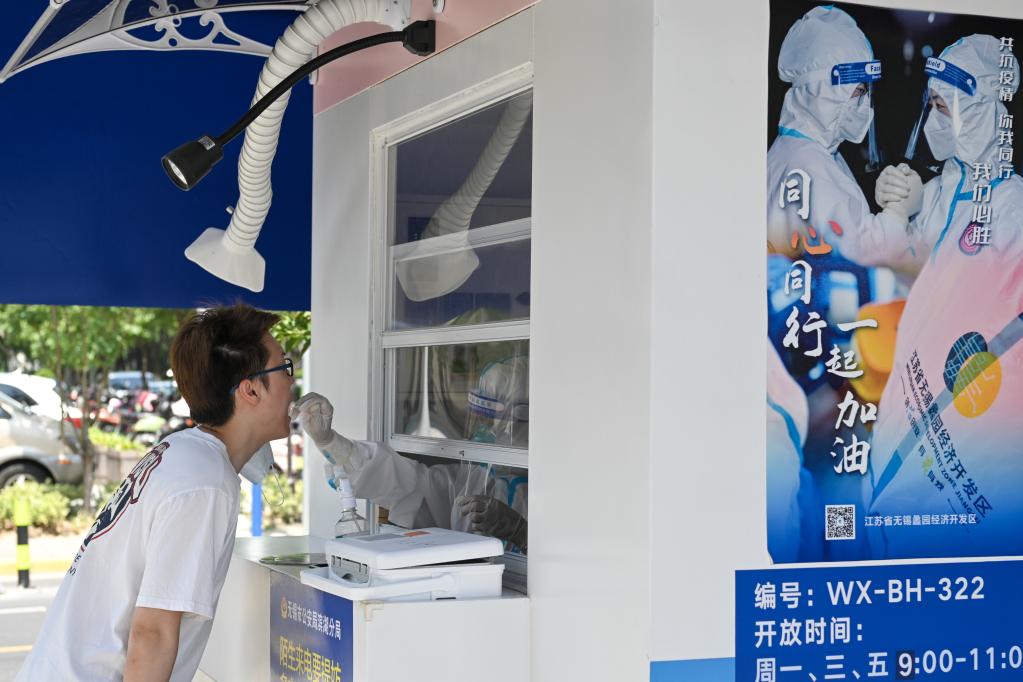
On July 5, a citizen was sampling nucleic acid at a nucleic acid sampling point in Liyuan Street, Binhu District, Wuxi City. Xinhua News Agency reporter Li Boshe
Wang Liping introduced that after the outbreak, if the conditions such as "clear source of infection", "clear transmission chain" and "no community transmission" are met through investigation, it is not necessary to carry out all-staff nucleic acid testing in the area where the epidemic occurred, and nucleic acid screening will be focused on the risk areas and people with time and space intersection.
If, according to the investigation, the transmission chain is unclear, there are many risk places and risk personnel, and the risk personnel are highly mobile, and there is a risk of spread of the epidemic, it is necessary to start the nucleic acid detection for all the people in the region. The detection range, detection strategy and termination conditions of nucleic acids in different regions are clearly defined in the scheme.
How to divide high school low-risk areas? Epidemic-free counties implement normalized prevention and control.
According to the ninth edition of the prevention and control plan, high, middle and low risk areas are divided in counties (cities, districts and banners) with epidemic situations. In counties (cities, districts and banners) where there is no epidemic, normalized prevention and control measures are implemented throughout the region.
Chang Zhaorui, a researcher at the Infectious Diseases Management Office of China CDC, said that high-risk areas refer to the places where cases and asymptomatic infected people live, as well as areas such as workplaces and activities with frequent activities and high risk of epidemic spread. In principle, they are defined by residential communities or villages, and the scope of risk areas can be judged and adjusted according to the results of epidemiological investigations. In high-risk areas, the measures of "staying at home and on-site service" are adopted. For people in high-risk areas with cross-regional spillover, centralized isolation medical observation was taken for 7 days.
Medium-risk areas refer to areas where cases and asymptomatic infected people stay and move for a certain period of time, and may have the risk of epidemic spread, such as workplaces and activities. In the middle risk area, the control measures of "people don’t leave the area and take things at the wrong peak" are adopted. For the personnel in the middle-risk area with cross-regional spillover, take 7-day home isolation medical observation.
Low-risk areas refer to other areas in the counties (cities, districts and banners) where middle-high risk areas are located. In low-risk areas, the preventive measures of "personal protection and avoiding gathering" are adopted. People in low-risk areas who go out across regions should leave with a 48-hour negative nucleic acid test certificate. There is no need to take isolation and control measures for people in low-risk areas who go out across regions, but it is required to complete nucleic acid testing twice within 3 days and do a good job in personal health monitoring.
Does the latest mutant have an impact? The prevention and control plan is still applicable
Recently, Omicron BA.5 subfamily is becoming the main epidemic strain in the world, and it has caused a local clustering epidemic in China. Dong Xiaoping, chief virologist of China CDC, said that compared with other branches of Omikrongya, the overall pathogenicity of BA.5 has not changed significantly, and the ninth edition of the prevention and control plan is still applicable.
The ninth edition of the prevention and control plan puts the monitoring of virus in a higher position, embodies the hierarchical nucleic acid screening plan, encrypts the frequency of nucleic acid detection among occupational groups at risk, and adds antigen detection as a supplementary means of epidemic monitoring.
"These measures in the ninth edition of the prevention and control plan are effective for the sub-branches of BA.4 and BA.5." Dong Xiaoping said.